
In today’s interconnected global economy, technology transfer has become a cornerstone of international business collaboration. For foreign investors eyeing opportunities in China—the world’s second-largest economy and a manufacturing powerhouse—understanding the intricate web of technology transfer regulations isn’t just advisable; it’s essential for survival.
The stakes are extraordinarily high. A single misstep in navigating China’s technology transfer landscape can result in deals collapsing at the final hour, licenses being denied, or worse—substantial fines and reputational damage that ripple across your global operations. Consider the reality facing a German automotive supplier that spent eighteen months negotiating a joint venture, only to discover their planned technology transfer required export licenses they hadn’t anticipated. The deal was delayed by another year while they scrambled to achieve compliance.
China’s technology transfer regulations directly impact every aspect of your business operations—from the intellectual property you can legally share with Chinese partners, to the data you can transmit across borders, to whether your entire investment structure will survive regulatory scrutiny. These regulations shape your compliance obligations, influence your strategic planning, and ultimately determine whether your China market entry succeeds or fails. For businesses already operating in China, these rules govern ongoing operations, partnerships, and the fundamental question of what technologies can move in and out of the country.
The regulatory environment has intensified significantly in recent years. China has strengthened its national security framework around technology, tightened controls on data flows, and expanded scrutiny of foreign investments in strategic sectors. What was permissible three years ago may now trigger comprehensive security reviews. Understanding these regulations isn’t a one-time compliance exercise—it’s an ongoing strategic imperative that requires constant vigilance and expert guidance.
Understanding the Core Framework: What Qualifies as Technology Transfer
Before you can comply with China’s technology transfer regulations, you need to understand precisely what falls under regulatory oversight. The scope is broader than many foreign investors initially assume, extending far beyond simple patent licensing agreements.
Under Chinese law, technology transfer encompasses any cross-border movement of technology ownership or usage rights. This includes patent transfers, software copyright licensing, trade secret sharing, technical know-how exchange, and even technical training programs that convey proprietary methodologies under Chinese Contract Law. If you’re planning to establish a joint venture in China that involves sharing manufacturing processes, you’re engaging in technology transfer. If you’re licensing software to a Chinese distributor, that’s technology transfer. If you’re providing technical specifications to a Chinese contract manufacturer, you’re potentially triggering regulatory requirements.
The regulatory framework rests on several foundational laws that work in concert. The Regulations on Technology Import and Export Administration establish the basic licensing requirements and classification system for technology transfers. The Export Control Law, implemented in December 2020, significantly expanded China’s authority to control technology flows based on national security considerations. The Foreign Investment Law governs how foreign capital and associated technologies enter strategic industries. The Cybersecurity Law, Data Security Law, and Personal Information Protection Law (PIPL) create overlapping obligations for any technology transfer involving data or digital systems.
Two concepts deserve special attention: dual-use items and controlled technologies. Dual-use items are goods, software, or technologies that have both civilian and potential military applications. The list is extensive and includes encryption technology, certain manufacturing equipment, advanced materials, and aerospace technologies. Even if your business is purely commercial, if your technology could theoretically be adapted for military purposes, it falls under heightened scrutiny.
Controlled items represent an even stricter category—technologies that China has explicitly designated as subject to export controls for national security or foreign policy reasons. Recent years have seen rapid expansion of this list, encompassing emerging technologies like artificial intelligence algorithms, quantum computing systems, and advanced semiconductor design tools.
The national security framework looms over all technology transfers. Chinese regulators now routinely assess whether proposed transfers could impact national security, a deliberately broad standard that grants authorities substantial discretion. This isn’t abstract legal theory—it’s a practical reality affecting real deals. A U.S. software company recently faced an eight-month security review for what seemed like a straightforward licensing agreement, simply because their product involved data analytics that could theoretically be applied to sensitive sectors.

Practical Implications: What You Must Do Before Transferring Technology
Understanding the legal framework is foundational, but foreign investors need practical guidance on how these regulations affect actual business operations. The implications touch every stage of technology transfer, from initial planning through ongoing compliance.
Licensing Requirements: The Gateway to Compliance
China operates a three-tiered licensing system for technology transfers: prohibited, restricted, and freely importable technologies. Prohibited technologies cannot be transferred into China under any circumstances—these typically involve technologies that threaten national security or violate international obligations. Restricted technologies require government approval before transfer, a process that can take months and involves substantial documentation demonstrating the technology’s legitimate business purpose and security safeguards.
Most technology transfers fall into the restricted category, which means obtaining the appropriate license before signing your deal. This isn’t a formality to address after agreements are signed; license applications require detailed technical specifications that Chinese authorities will scrutinize. Learn more about protecting your manufacturing agreements in China. A British engineering firm learned this lesson painfully when they signed a manufacturing agreement assuming their technology was freely importable, only to discover it required restricted-category licensing that their Chinese partner was ultimately denied.
End-Use and End-User Controls: Know Your Counterparty
Chinese regulations impose strict end-use and end-user controls that make you responsible for ensuring your technology isn’t misused or redirected to unauthorized parties. This creates substantial due diligence obligations. You must verify your Chinese partner’s identity, business legitimacy, and intended use of the technology. You must contractually bind them to using the technology only for specified purposes and prohibit unauthorized transfers to third parties.
The regulatory burden extends beyond your immediate partner. You’re expected to understand your technology’s ultimate end-use and maintain reasonable monitoring systems to detect potential violations. For complex supply chains where your technology might pass through multiple entities before reaching its final application, this creates significant challenges.
Technology Classification: The First Critical Step
Before initiating any technology transfer discussions, you must accurately classify your technology under Chinese regulatory schemes. This requires technical analysis and often legal interpretation. Is your manufacturing process dual-use? Does your software incorporate encryption that triggers export controls? Do your technical specifications contain information that China considers sensitive?
Misclassification isn’t just an administrative error—it’s a compliance failure that can invalidate your entire transaction. Yet classification is often ambiguous, particularly for emerging technologies that don’t fit neatly into existing categories. The advanced materials developed by an Australian mining technology company, for example, weren’t explicitly listed in any control category, but regulators determined they had potential dual-use applications requiring licensing.
Foreign Investment Scrutiny: When Technology Meets Capital
Technology transfers often occur within foreign investment structures—joint ventures, wholly foreign-owned enterprises, or partnership agreements. Chinese authorities now conduct enhanced security reviews of foreign investments in sensitive sectors, particularly technology-related investments. The review process examines not just the capital structure but the technologies that will be transferred, the expertise that foreign partners bring, and the potential for foreign control over critical technologies.
Sectors facing heightened scrutiny include semiconductors, artificial intelligence, biotechnology, aerospace, and new energy technologies. If your investment involves these sectors, anticipate comprehensive reviews that may require restructuring your deal to satisfy national security concerns. Some investors have found success by limiting technology transfer scopes, implementing governance structures that provide Chinese partners greater control over sensitive technologies, or accepting ongoing monitoring requirements.
Data and Privacy: The Overlooked Complexity
Many technology transfers involve data flows—customer information embedded in software, operational data necessary for equipment functioning, or technical data supporting ongoing support services. Under China’s PIPL and Data Security Law, cross-border data transfers face stringent requirements that many foreign investors overlook until it’s too late.
Personal information cannot be transferred outside China without meeting specific legal mechanisms: passing a security assessment, obtaining certification, or using standard contractual clauses approved by Chinese authorities. Technical data may require classification and security assessments. Even anonymized data faces restrictions if it can be re-identified or involves sensitive categories.
The interplay between technology transfer regulations and data protection requirements creates compound compliance obligations. Your technology licensing agreement might be properly structured, but if the technology’s operation requires data flows that violate PIPL, your entire arrangement becomes legally problematic.
Cross-Border Data and Privacy: Understanding the PIPL Dimension
China’s Personal Information Protection Law (PIPL), which took effect in November 2021, has fundamentally reshaped how foreign companies must approach technology transfers involving personal data. For many businesses, PIPL compliance is inseparable from technology transfer compliance—yet they’re governed by distinct regulatory frameworks requiring coordinated approaches.
PIPL applies whenever you process personal information of individuals in China, regardless of where your company is established. If your technology transfer involves customer data, employee information, or any identifiable personal information, PIPL obligations activate immediately.
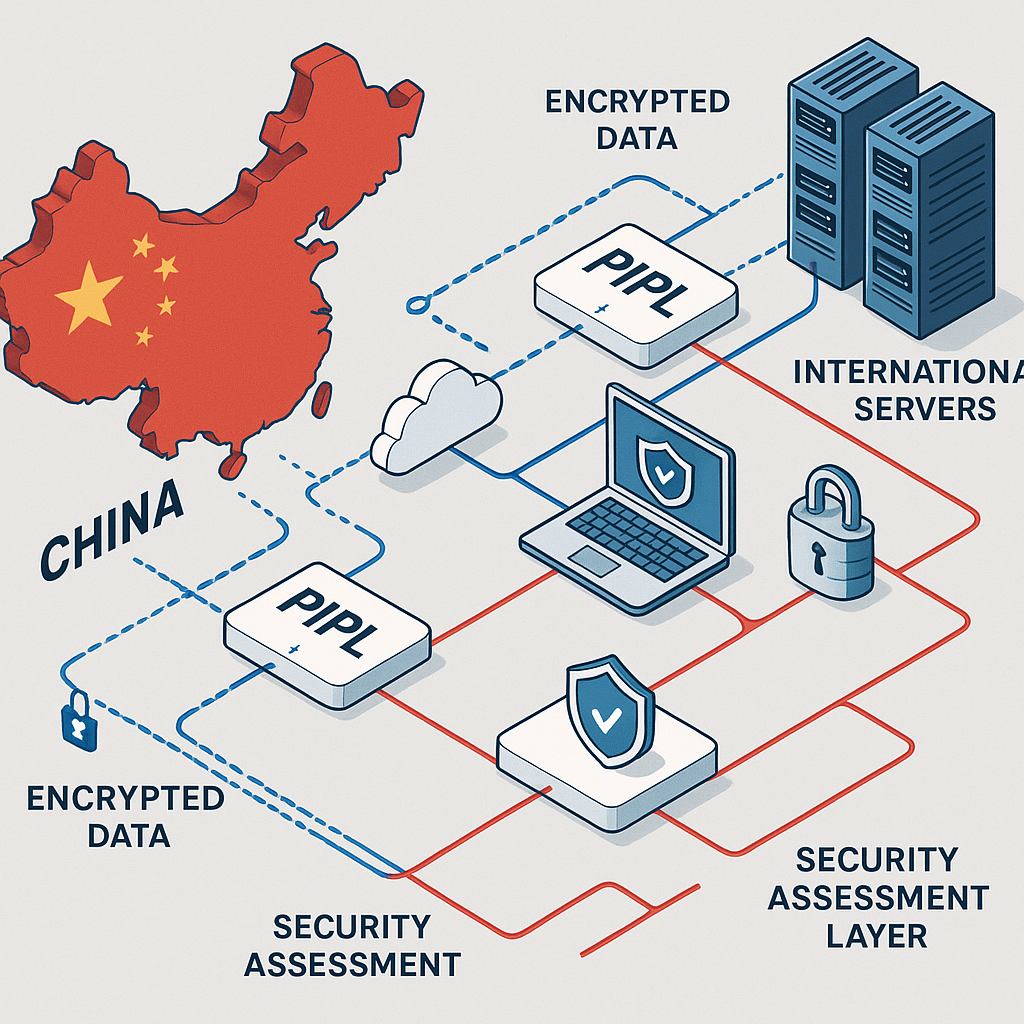
The law establishes three legal pathways for cross-border personal information transfers. First, you can pass a security assessment conducted by the Cyberspace Administration of China—a process appropriate for critical infrastructure operators or large-scale data transfers. Second, you can obtain personal information protection certification from approved certification bodies, demonstrating your data handling meets Chinese standards. Third, you can execute standard contractual clauses with your overseas recipient, binding them to PIPL’s protection requirements.
None of these pathways is simple. Security assessments require extensive documentation about data types, transfer purposes, security measures, and recipient capabilities. Certification involves audits and ongoing monitoring. Standard contractual clauses must follow specific templates and may require filing with regulators depending on circumstances.
The Data Security Law adds another layer, classifying data into different security levels and imposing corresponding protection requirements. Important data—a term encompassing data that could impact national security, economic operations, or public welfare—faces additional restrictions. Core data, which relates to national security or critical economic sectors, faces the strictest controls and typically cannot be transferred abroad without specific government approval.
For technology transfers, the intersection is critical. If you’re transferring industrial control software that will collect operational data from Chinese factories, you’re navigating both technology licensing requirements and data security obligations. If your joint venture will involve sharing customer databases to support service operations, you need both technology transfer approvals and PIPL-compliant data transfer mechanisms.
A Canadian software company recently spent fourteen months establishing compliance for a seemingly straightforward cloud platform deployment in China. The technology transfer licensing took four months. The PIPL compliance framework—including security assessments, standard contractual clauses for data transfers back to Canadian servers, and restructuring to minimize personal information flows—took another ten months. The lesson: these regulations don’t operate in isolation; they compound.
Step-by-Step Compliance: Building Your Framework
Successfully navigating China’s technology transfer regulations requires systematic preparation and ongoing vigilance. Here’s the practical roadmap foreign investors should follow:
Step 1: Conduct Comprehensive Technology and Data Classification
Begin by cataloging all technologies and data involved in your planned transfer. Work with technical experts to identify potential dual-use applications, controlled technology elements, and sensitive data categories. This analysis should happen before you begin negotiating deal terms, as classification outcomes directly impact deal structure feasibility.
Step 2: Screen Your Counterparties Thoroughly
Implement robust due diligence on Chinese partners. Verify business registrations, confirm operational legitimacy, and investigate whether they’ve faced regulatory sanctions. Check whether they appear on relevant sanctioned entity lists. Understand their customer base and end-use applications for your technology. This screening isn’t just good business practice—it’s a regulatory requirement that you must document.
Step 3: Obtain Required Licenses Before Signing Agreements
For restricted technologies, initiate license applications early, understanding the process may take four to six months or longer. Prepare detailed technical documentation, business justifications, and security protocols. Consider engaging Chinese legal counsel familiar with specific regulatory agencies handling your application.
Step 4: Implement Internal Compliance Programs
Establish corporate policies governing technology transfers. Train employees on classification requirements and approval workflows. Create internal controls ensuring no unauthorized technology sharing occurs, even in informal technical discussions. Document compliance efforts systematically—Chinese authorities increasingly expect evidence of robust compliance programs, not just transactional compliance.
Step 5: Structure Foreign Investments to Minimize Security Review Risks
When technology transfer occurs within investment structures, design governance arrangements that address national security concerns proactively. Consider minority investment positions in sensitive sectors, governance structures granting Chinese partners control over critical decisions, or phased technology transfers triggered by achievement of specific milestones.
Step 6: Establish PIPL and Data Security Law Compliance Frameworks
For transfers involving data flows, select appropriate legal mechanisms for cross-border transfers. Implement data minimization strategies reducing the volume of personal information requiring transfer. Deploy encryption and security measures meeting Chinese standards. Consider data localization strategies where feasible, storing Chinese data on Chinese servers to avoid cross-border transfer complexities altogether.
Step 7: Monitor Regulatory Updates Continuously
China’s technology and data regulations are evolving rapidly, with new rules, expanded control lists, and revised enforcement priorities emerging regularly. Establish monitoring systems tracking regulatory developments. Subscribe to official government announcements from the Cyberspace Administration of China, Ministry of Commerce, and other relevant authorities.
Step 8: Engage Expert Guidance Throughout the Process
The complexity and ambiguity inherent in China’s technology transfer landscape makes expert guidance invaluable. Chinese legal counsel familiar with specific agencies and current enforcement priorities can navigate ambiguities that trip up foreign companies. Technology consultants can assist with classification challenges. Data protection specialists can design compliant transfer mechanisms.
Risk Management Scenarios: Learning from Others’ Challenges
Understanding abstract regulations is important, but seeing how they manifest in real situations crystallizes the risks. Consider these scenarios that foreign investors frequently encounter:
Scenario 1: The Unintentional Dual-Use Technology Transfer
An American robotics company negotiated a manufacturing partnership with a Chinese supplier, planning to transfer specifications for industrial automation systems. The company classified their technology as freely importable since it was designed purely for civilian manufacturing. However, regulators determined that the precision control systems had potential military applications for missile guidance systems—making them dual-use technologies requiring restricted-category licensing.
Mitigation Strategy: Conduct technical reviews with dual-use perspectives in mind. When classification is ambiguous, engage Chinese regulatory authorities informally to understand their classification approach before proceeding with deals. Build contingency timeframes into deal negotiations assuming license requirements may emerge.
Scenario 2: The Security Review Triggered by Investment Structure
A European investment fund acquired a 30% stake in a Chinese artificial intelligence company, with plans to transfer advanced algorithms developed by the European parent company. Despite the minority position, the investment triggered a foreign investment security review because the sector was deemed sensitive and the transferred technology gave the European investor potential influence over a critical Chinese technology company.
Mitigation Strategy: For investments in sensitive sectors (semiconductors, AI, biotechnology, aerospace, new energy), anticipate security reviews regardless of investment size. Structure deals with security review contingencies. Consider whether technology transfer can be structured separately from equity investment, potentially with Chinese partners taking operational control over sensitive technologies while foreign investors retain financial interests.
Scenario 3: The Data Transfer Oversight
A Japanese software company licensed customer relationship management software to a Chinese distributor. The license agreement was properly structured and approved. However, the software’s operation required ongoing synchronization of customer data back to Japanese servers for system updates and maintenance. The company hadn’t implemented PIPL-compliant data transfer mechanisms. When discovered during a routine regulatory inspection, the company faced substantial fines and operational suspension until compliance was achieved.
Mitigation Strategy: Analyze technology transfers holistically, identifying all data flows implicit in technology operation. Implement appropriate PIPL mechanisms (security assessment, certification, or standard contractual clauses) before operationalizing technology transfers. Consider technical solutions like local data storage that minimize cross-border data flows.
Scenario 4: The End-Use Diversion
An Australian mining equipment manufacturer transferred specialized drilling technology to a Chinese manufacturing partner under agreements limiting use to civilian mining operations. The Chinese partner later provided equipment incorporating the technology to a state-owned enterprise involved in military infrastructure projects—a prohibited end-use. Despite contractual prohibitions, the Australian company faced regulatory scrutiny for failing to implement adequate monitoring.
Mitigation Strategy: Implement contractual end-use restrictions with specific monitoring rights. Conduct periodic audits of Chinese partners’ operations. Require detailed reporting on downstream customers and applications. Build contractual termination rights triggered by end-use violations. Maintain documentary evidence of compliance efforts.
Key Takeaways: Your Compliance Checklist
As foreign investors navigate China’s technology transfer landscape, several critical principles should guide your approach:
First, Always Assess Technology Sensitivity Early: Classification determines your entire compliance pathway. Invest time upfront understanding whether your technology is prohibited, restricted, or freely transferable. Explore how AI legal tools can accelerate compliance assessment. Don’t rely on assumptions or general industry practices—conduct specific analysis for your particular technologies.
Second, Anticipate Security Reviews for Strategic Investments: If your investment involves strategic sectors or significant technology transfer components, build security review time and uncertainty into your planning. Structure deals with regulatory approval contingencies. Consider how governance arrangements might be adjusted to address security concerns while preserving commercial value.
Third, Integrate Data Protection into Technology Transfer Planning: PIPL and the Data Security Law aren’t afterthoughts—they’re fundamental compliance requirements that must be addressed from the outset. Analyze data flows implicit in your technology transfer, implement appropriate legal mechanisms for cross-border transfers, and consider technical solutions that minimize compliance complexity.
Fourth, Build Comprehensive Compliance Frameworks: Effective compliance isn’t transactional—it’s systematic. Develop corporate policies, implement internal controls, train employees, and maintain documentation. Learn about building frameworks that pass regulatory audits. Chinese regulators increasingly expect evidence of compliance programs, not just deal-specific compliance efforts.
Fifth, Accept Ongoing Monitoring Obligations: Technology transfer compliance doesn’t end when licenses are issued or deals close. You have ongoing responsibilities to ensure technologies aren’t misused, end-use restrictions are honored, and data protection remains effective. Build monitoring capabilities into your operations.
Sixth, Engage Expert Guidance Strategically: The complexity, ambiguity, and rapid evolution of China’s technology transfer regulations make expert guidance essential. This isn’t an area where general corporate counsel or limited research suffices. You need specialists familiar with current enforcement priorities, agency practices, and sector-specific nuances.
The challenges are substantial, but so are the opportunities. China represents massive market potential for foreign investors willing to navigate its regulatory landscape thoughtfully. Success requires understanding that compliance isn’t an obstacle to business—it’s the foundation enabling sustainable operations.
iTerms AI Legal Assistant is specifically designed to help foreign investors navigate these complexities. Built on FaDaDa’s decade of experience in Chinese legal technology and serving over 100,000 global clients, iTerms provides specialized AI-powered legal intelligence that bridges Chinese and international legal frameworks. Whether you need contract drafting that integrates technology transfer compliance requirements, real-time guidance on classification questions, or comprehensive regulatory analysis, iTerms offers the bilingual legal expertise and practical business focus that international businesses require. Our platform doesn’t just explain regulations—it provides actionable compliance pathways tailored to your specific circumstances, helping you make informed decisions before signing deals that will shape your China operations for years to come.