
The traditional corporate investigation process has long been a bottleneck for businesses seeking to enter or expand in China. Teams of lawyers and analysts would spend months combing through documents, verifying credentials, and assessing risks before any deal could move forward. But a fundamental shift is underway. AI-driven due diligence is collapsing timelines that once stretched across quarters into workflows measured in days, fundamentally transforming how international businesses approach China corporate investigations.
At the heart of this transformation lies the automation of document review, data extraction, and pattern recognition—tasks that historically consumed the majority of investigation time. Consider a typical cross-border manufacturing partnership: evaluating a Chinese supplier once required manually reviewing business licenses, financial statements, export records, and compliance documentation across multiple regulatory databases. Each document needed translation, verification, and cross-referencing against known risk indicators. A single investigation could easily require 500 hours of professional time—time that could be better spent understanding China business laws that govern your operations.
Today, AI systems can process the same volume of documentation in hours rather than weeks. Advanced natural language processing engines parse Chinese regulatory filings, extract key data points, and flag inconsistencies automatically. Machine learning algorithms trained on millions of corporate records identify patterns that human reviewers might miss—subtle discrepancies in registration dates, unusual corporate structure changes, or affiliations with sanctioned entities. What emerges is not just speed, but a depth of analysis that was previously economically unfeasible for all but the largest transactions.
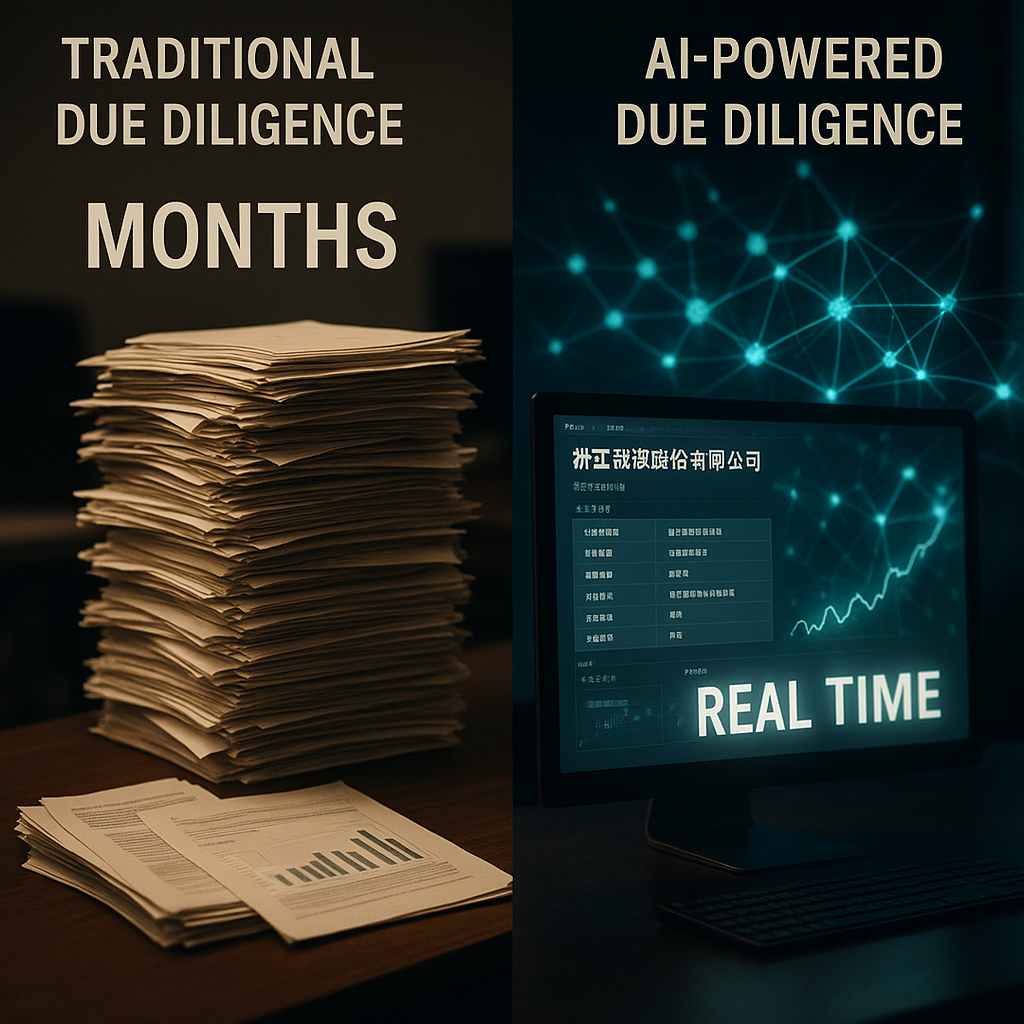
For international businesses, this acceleration represents more than convenience. In fast-moving markets like China, where regulatory environments shift quickly and competitive advantages can be fleeting, the ability to conduct thorough due diligence in days rather than months can mean the difference between securing a strategic partnership or watching competitors claim the opportunity. A European electronics manufacturer recently shared that AI-enabled due diligence allowed them to evaluate and onboard three qualified Chinese component suppliers in the time their previous process required for assessing a single vendor.
Navigating China’s Unique Investigation Challenges
China presents a particularly complex environment for corporate investigations, one where AI’s capabilities prove especially valuable. The regulatory landscape involves overlapping jurisdictions across national, provincial, and municipal levels, each maintaining separate databases and filing requirements. State involvement in enterprise operations adds layers of complexity that don’t exist in most Western markets. Information transparency varies dramatically between sectors and regions, creating an environment where traditional investigation methods often struggle.
Foreign businesses face specific challenges that make China due diligence fundamentally different from investigations in other markets. A technology company considering a joint venture in Shenzhen must navigate not only standard corporate verification but also complex questions about state ownership structures, Communist Party involvement in corporate governance, and potential military-civil fusion affiliations—considerations that extend far beyond typical China business legal requirements. These considerations extend far beyond what’s typically captured in standard due diligence checklists designed for Western jurisdictions.
The opacity of certain information channels compounds these challenges. While China has made significant progress in digitizing business registrations and regulatory filings, critical information often remains scattered across disconnected systems or embedded in documents that require specialized knowledge to interpret correctly. Beneficial ownership structures can involve multiple holding companies across different regions, making it difficult to trace ultimate control. Historical compliance violations might be recorded in local enforcement databases that aren’t easily accessible through standard commercial information services.
AI enhances due diligence in this environment by providing capabilities specifically designed for these challenges. Natural language processing systems trained on Chinese legal and regulatory language can parse documents that contain context-dependent terminology where direct translation would miss critical nuances. Machine learning models can identify connections between entities even when corporate structures deliberately obscure relationships. Pattern recognition algorithms detect anomalies in financial data that might indicate unreported state involvement or hidden regulatory issues.
Real-world impact becomes clear when examining specific use cases. An Australian mining company needed to verify the independence of several potential Chinese partners, ensuring they had no undisclosed affiliations with state-controlled competitors. Traditional investigation methods would have required months of document requests, interviews, and manual cross-referencing of corporate registrations. An AI-driven approach completed the initial screening in four days, identifying two entities with indirect state connections that weren’t apparent from their primary registration documents. The accelerated timeline allowed the company to redirect negotiations toward truly independent partners without losing momentum in a time-sensitive transaction.
Regulatory and Data Protection Considerations
Conducting AI-driven due diligence in China requires careful attention to data protection regulations that have evolved significantly in recent years. The Personal Information Protection Law (PIPL), which took effect in November 2021, establishes comprehensive requirements for processing personal data that often surfaces during corporate investigations. Organizations must develop robust data privacy compliance China frameworks to navigate these regulations effectively. Information about company directors, key employees, and beneficial owners all falls under PIPL’s scope, creating compliance obligations that investigators must address.
Cross-border data flows present particular challenges for international businesses conducting due diligence from outside China. PIPL restricts the transfer of personal information collected in China to foreign jurisdictions, with specific requirements for security assessments, standard contracts, or certification mechanisms depending on the volume and sensitivity of data involved. An AI due diligence platform processing information about Chinese company personnel must ensure that data handling practices align with these transfer restrictions.
The regulatory framework extends beyond personal information. China’s Cybersecurity Law and Data Security Law establish tiered classifications for data importance, with enhanced protection requirements for “important data” related to critical information infrastructure, national security, or economic security. Due diligence investigations that touch on sectors deemed sensitive—including telecommunications, energy, finance, or advanced manufacturing—must account for these classifications when determining how information can be collected, processed, and shared. Understanding China technology transfer regulations becomes critical when investigations involve proprietary technologies or intellectual property.
Designing AI systems that align with these requirements demands architectural decisions from the outset. Privacy-by-design principles become essential rather than optional. Data minimization strategies ensure that AI platforms collect only information necessary for legitimate due diligence purposes. Purpose limitation controls prevent collected data from being repurposed beyond the specific investigation context. Storage limitation mechanisms automatically dispose of investigation data after defined retention periods.
Practical implementation often involves deploying AI due diligence capabilities within Chinese jurisdictions to minimize cross-border data transfer requirements. Processing personal information within China and transferring only anonymized risk assessments and non-personal analytical outputs reduces regulatory friction while maintaining investigation effectiveness. For investigations that must involve cross-border data flows, implementing PIPL-compliant standard contract clauses and conducting security impact assessments becomes standard operating procedure.
The compliance burden extends to ongoing auditability. Regulatory authorities increasingly expect organizations to demonstrate how automated decision-making systems process personal information and arrive at conclusions. AI systems used for due diligence must maintain audit trails that document data sources, processing logic, and decision criteria. When an AI platform flags a potential compliance risk in a Chinese corporate investigation, investigators must be able to trace that determination back to specific data points and analytical reasoning—both to validate the finding and to demonstrate regulatory compliance if questioned.
Accelerating Investigations Through Practical AI Applications
The practical application of AI in China-related corporate investigations manifests across several critical dimensions, each contributing to dramatically compressed timelines while enhancing analytical depth. Multilingual data handling represents perhaps the most immediate value proposition. Due diligence investigations in China inevitably involve documentation in both Chinese and English, often with inconsistent translations or terminology that carries different legal implications across languages.
Advanced AI systems trained on Chinese legal corpus and regulatory language can process original Chinese documents without relying on potentially misleading translations. A natural language understanding engine that comprehends Chinese contract law terminology recognizes that “不可抗力” (force majeure) in a Chinese manufacturing agreement carries specific legal implications under Chinese Civil Code provisions that may differ from common law interpretations. This contextual understanding prevents the misinterpretations that frequently arise when investigators work primarily from translated documents.
Document analysis capabilities extend far beyond simple text extraction. When evaluating a Chinese supplier’s financial health, AI systems can simultaneously analyze tax filings, customs export records, and bank statements to identify inconsistencies that manual review might miss. A European fashion retailer discovered through AI-driven analysis that a potential manufacturing partner’s reported export volumes significantly exceeded what their stated production capacity should support—a 🚩 red flag indicating either unreported production facilities or possible export credential fraud. Traditional document review hadn’t caught this discrepancy because the relevant data points existed in separate documents reviewed weeks apart.
Risk scoring mechanisms aggregate multiple data sources into quantified assessments that accelerate decision-making. Rather than requiring senior executives to digest hundreds of pages of investigation findings, AI platforms generate structured risk profiles highlighting critical concerns. A risk score might integrate factors including regulatory compliance history, financial stability indicators, ownership structure transparency, litigation records, and sanctions screening results into a single dashboard that allows rapid comparison across multiple potential partners.
Pattern recognition becomes particularly powerful when applied to Chinese corporate behavior over time. Machine learning models trained on millions of corporate evolution patterns can identify unusual trajectories that merit deeper investigation. When a Beijing technology company suddenly restructured its ownership through a complex series of offshore entities before seeking foreign investment, AI pattern recognition flagged the restructuring as statistically anomalous compared to typical pre-investment corporate preparations. Further investigation revealed the restructuring was designed to obscure recent regulatory violations—information that wasn’t disclosed in the company’s investment materials.
Continuous monitoring capabilities extend due diligence beyond point-in-time investigations into ongoing risk management. Once AI systems establish a baseline understanding of a Chinese business partner, they can monitor for changes that might affect the relationship’s risk profile. Automated alerts notify compliance teams when partners undergo unexpected leadership changes, receive regulatory citations, or appear in litigation records. A Japanese automotive components manufacturer avoided significant supply chain disruption when their AI monitoring system detected that a key Chinese supplier had been cited for environmental violations likely to result in production restrictions—information that surfaced two weeks before the supplier disclosed the issue.
The integration of public and commercial data sources amplifies these capabilities. AI platforms don’t rely solely on information provided by investigation subjects. They cross-reference company claims against Chinese corporate registration databases, court judgment records, customs data, and regulatory enforcement actions. When a Shanghai logistics company represented that it held all necessary licenses for hazardous materials transport, AI verification quickly identified that one of their subsidiary operations lacked proper provincial-level certification—a gap that could have exposed the foreign client to liability.
Implementation Best Practices for AI-Driven Due Diligence
Successfully implementing AI-driven due diligence for China corporate investigations requires attention to several critical success factors that determine whether technology investments deliver promised value. Organizations exploring cross-border legal technology must understand these implementation principles to maximize ROI. Data quality stands as the foundation of effective AI implementation. Machine learning models produce results only as reliable as the data they process, and China corporate data often presents quality challenges including incomplete records, inconsistent formatting across jurisdictions, and information that requires specialized context to interpret correctly.
Organizations achieving success with AI due diligence invest heavily in data curation and validation. This means developing relationships with authoritative Chinese data providers, implementing verification protocols that cross-reference information across multiple sources, and building feedback loops that allow human experts to correct AI misinterpretations. A Canadian investment firm improved their AI platform’s accuracy by 34% through a structured program where senior China analysts reviewed and corrected a sample of AI-generated risk assessments, with corrections fed back into model training.
Human-in-the-loop oversight remains essential despite automation advances. AI excels at processing vast information volumes and identifying patterns, but human judgment proves irreplaceable for contextual interpretation and strategic decision-making. Effective implementations establish clear protocols defining when AI findings require human review before action. High-risk determinations, unusual patterns without clear precedent, and investigations involving sensitive sectors all benefit from human expert validation before conclusions become basis for business decisions.
The design of these human-AI interaction points significantly impacts both accuracy and efficiency. Rather than requiring human review of all AI output—which negates speed advantages—sophisticated implementations use confidence scoring to route only ambiguous cases for human attention. When an AI system determines with 95% confidence that a Chinese manufacturer holds all required environmental permits, automated processing continues. When confidence drops below defined thresholds, the case routes to a human investigator. This approach preserves efficiency while maintaining oversight where it matters most.
Privacy-by-design principles must be embedded into AI architectures from inception rather than added as compliance afterthoughts. This means implementing technical controls including data encryption, access restrictions, and automated deletion protocols as core system features. When processing Chinese personal information under PIPL requirements, privacy-by-design architecture ensures that data protection isn’t dependent on procedural compliance but rather enforced by system design that makes violations technically difficult.
Managing cross-border compliance complexity requires deliberate architectural choices. Organizations operating globally must reconcile China’s data protection requirements with compliance obligations in other jurisdictions where they operate. A European company subject to GDPR faces overlapping but distinct requirements from Chinese PIPL when conducting due diligence on Chinese partners. Effective AI implementations develop unified data governance frameworks that satisfy the most stringent requirements across all applicable jurisdictions, avoiding the operational complexity of maintaining separate compliance protocols for different markets.
Model risk management deserves explicit attention in AI due diligence applications. Machine learning models can embed biases from training data, produce false positives that waste investigation resources, or generate false negatives that allow risks to proceed undetected. Organizations should consider how artificial intelligence systems are validated in financial and legal contexts to establish appropriate model governance frameworks. Robust implementations include ongoing model performance monitoring, regular validation against ground truth outcomes, and transparent documentation of model limitations. When an AI risk scoring model disproportionately flags companies from certain Chinese regions, model validation processes should detect this pattern and determine whether it reflects genuine risk concentration or inappropriate bias requiring correction.
The pace of regulatory evolution in both AI governance and Chinese business law demands that due diligence systems remain adaptable. China’s AI regulations continue developing, with new requirements for AI system labeling, algorithmic transparency, and ethics review. Due diligence platforms must be architected for rapid update as regulatory frameworks evolve. Organizations that view AI implementation as a one-time technology deployment inevitably find their systems becoming outdated; those that establish continuous improvement processes maintain effectiveness as contexts change.
Transforming Due Diligence for Complex Business Environments
The transformation of China corporate investigations from months-long endeavors to processes completing in days represents more than incremental improvement—it fundamentally changes what’s possible for international businesses navigating complex cross-border relationships. When due diligence timelines compress by 80% while analytical depth increases, businesses can evaluate more potential partners, respond to opportunities faster, and allocate investigation resources more strategically.
This transformation proves particularly significant in environments like China where complexity has historically created barriers to entry for smaller organizations lacking extensive investigative resources. A mid-sized American manufacturing company previously limited their China sourcing to a small number of established suppliers because the cost and time required for thorough due diligence made exploring new partners economically impractical. Proper manufacturing contracts China combined with AI-driven due diligence enabled them to scale supplier relationships confidently. AI-driven investigation capabilities enabled them to evaluate a broader supplier base, ultimately identifying more cost-effective partners while maintaining rigorous risk management standards.
The competitive implications extend beyond individual transactions. Organizations that successfully implement AI-driven due diligence capabilities develop compound advantages over time. Each investigation generates data and insights that improve future investigations. Machine learning models become more accurate as they process more Chinese corporate information. Pattern recognition algorithms identify subtle risk indicators that emerge only through exposure to thousands of investigations. These learning effects create barriers to replication that grow stronger over time.
Yet technology alone doesn’t determine success. The organizations achieving most value from AI-driven due diligence combine technological capabilities with deep China expertise, robust compliance frameworks, and cultural understanding that algorithms cannot replace. AI accelerates and enhances human expertise rather than substituting for it. The most effective implementations involve China specialists working in partnership with AI systems, leveraging technology to handle information processing while applying irreplaceable human judgment to interpretation and strategic decision-making.
Looking forward, the continued evolution of both AI capabilities and China’s regulatory environment will further reshape corporate investigation practices. As natural language models become more sophisticated in handling Chinese legal context, as regulatory data becomes more accessible through government digitization initiatives, and as international compliance standards continue converging, the gap between investigation requirements and practical capabilities will continue narrowing.
At iTerms AI Legal Assistant, we recognize that effective China due diligence requires more than powerful algorithms—it demands a comprehensive understanding of Chinese legal frameworks, regulatory practices, and business culture combined with cutting-edge AI capabilities designed specifically for cross-border legal challenges. Our virtual legal assistant provides 24/7 support for navigating these complexities with precision and speed. Our platform builds on FaDaDa’s decade of experience serving over 100,000 clients navigating Chinese legal requirements, bringing that expertise to international businesses through AI-powered tools that make sophisticated China legal intelligence accessible and actionable.
The core insight driving our approach is that China corporate investigations shouldn’t be obstacles delaying business progress but rather accelerators enabling confident, informed decision-making. When due diligence processes that once required months finish in days without sacrificing thoroughness, international businesses gain the agility needed to succeed in dynamic markets while maintaining the risk management rigor that protects long-term interests.
The transformation of due diligence timelines from months to days isn’t simply about working faster—it’s about fundamentally expanding what becomes possible when sophisticated legal intelligence combines with advanced technology, delivered through platforms designed specifically for the unique challenges of China business engagement. As regulatory complexity increases and competitive pressures intensify, the organizations that thrive will be those that embrace these capabilities while maintaining unwavering commitment to legal accuracy, compliance integrity, and strategic wisdom.