
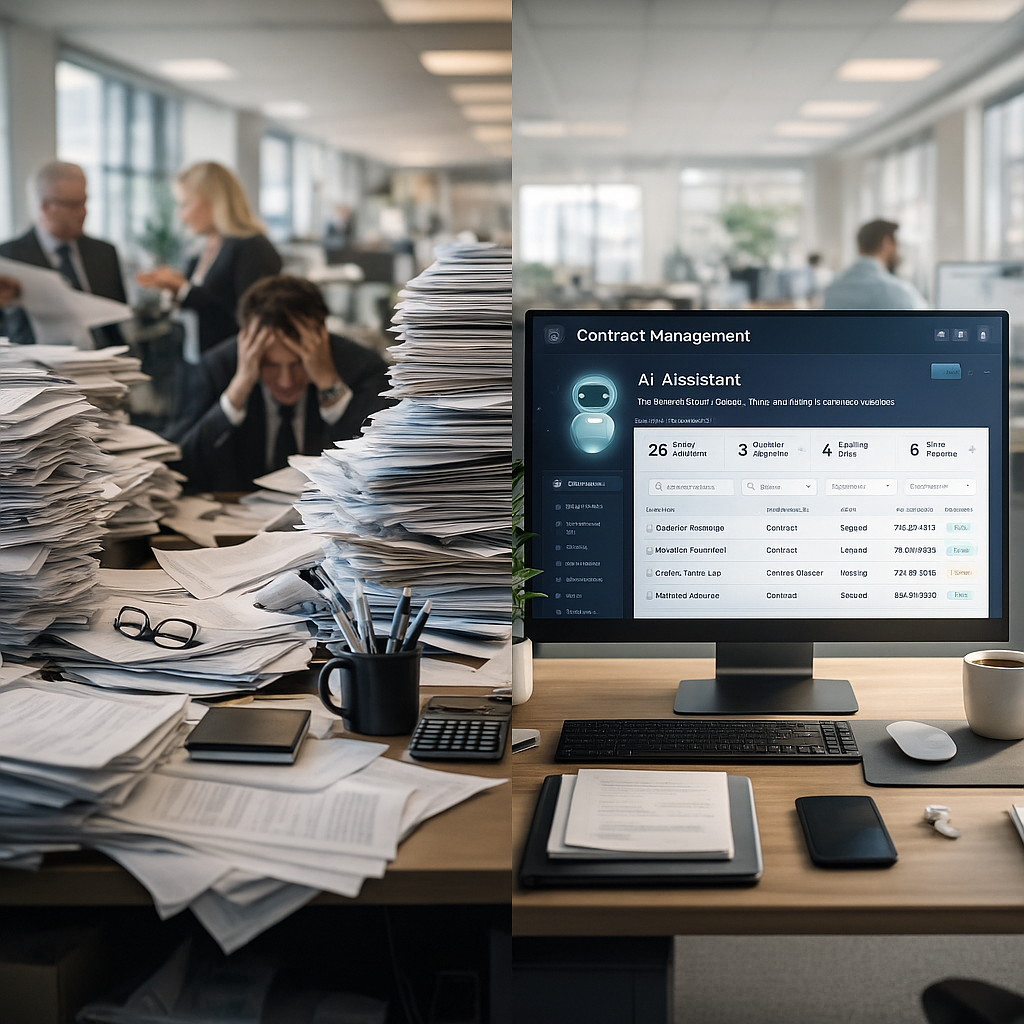
For decades, contract management in China has been synonymous with chaos. Stacks of paper contracts gathering dust in filing cabinets. Critical renewal dates slipping through the cracks. Legal teams drowning in manual reviews, struggling to keep pace with China’s evolving regulatory landscape. Foreign business owners entering the Chinese market quickly discovered that traditional contract management approaches—already cumbersome in their home countries—became exponentially more complex when dealing with bilingual agreements, unique Chinese legal frameworks, and cross-border compliance requirements.
But something fundamental is shifting. Chinese businesses, along with their international partners, are experiencing a breakthrough moment. Similar to how AI legal writing generators are transforming contract drafting, contract management AI is fundamentally reimagining how agreements are created and managed. Contract management AI is transforming what was once a administrative nightmare into a streamlined, intelligent process. This isn’t just about digitizing paperwork—it’s about fundamentally reimagining how contracts are created, managed, and enforced in one of the world’s most dynamic business environments.
For foreign business owners establishing operations in China, expatriates navigating personal legal matters, international legal professionals supporting China-related transactions, and global corporations managing Chinese partnerships, this transformation represents more than convenience. It’s the difference between thriving and merely surviving in the Chinese market. The chaos that once characterized contract management—with its missed obligations, compliance gaps, and endless manual reviews—is giving way to clarity, efficiency, and confidence.
The Intelligence Behind the Transformation
At the heart of this revolution lies sophisticated AI technology that goes far beyond simple document storage or basic templates. Modern contract management AI systems leverage advanced natural language processing specifically trained on Chinese legal frameworks, enabling them to understand not just the words on a page, but the legal concepts, cultural contexts, and regulatory nuances embedded within them.
Consider natural language processing capabilities designed for bilingual legal comprehension. When an international company drafts a manufacturing agreement with a Chinese supplier, the AI doesn’t merely translate terms—it maps legal concepts between Western and Chinese legal frameworks. A “force majeure” clause under common law carries different implications than its Chinese Civil Code equivalent. AI systems trained on China-specific legal knowledge bridge these gaps automatically, ensuring that contracts reflect accurate legal meanings in both jurisdictions.
Template-driven drafting represents another cornerstone of AI-powered contract management. But these aren’t generic templates copied from Western legal systems and poorly adapted to Chinese requirements. Leading platforms maintain extensive libraries built from attorney-reviewed contracts that have proven effective under Chinese law. Access to 10,000+ professionally vetted contract templates means that whether you’re establishing a wholly foreign-owned enterprise (WFOE), negotiating an IP licensing agreement, or drafting employment contracts compliant with China’s Labor Contract Law, you’re starting from a foundation of proven legal structures rather than guesswork.
The automated signing workflows integrated into AI contract management systems address a particularly thorny challenge for international businesses: coordinating approvals across time zones, languages, and organizational hierarchies. When a contract requires sign-off from executives in New York, Beijing, and Frankfurt, AI-powered workflows route documents intelligently, track status in real-time, and ensure that electronic signatures meet both international standards and China’s specific requirements for legally binding digital agreements.
For global corporate clients managing multiple Chinese partnerships, this efficiency translates directly to competitive advantage. Contracts that once took weeks to finalize now move through the system in days. Legal teams shift from administrative gatekeepers to strategic advisors. Risk is mitigated not through endless rounds of manual review, but through AI systems that flag compliance issues, identify missing clauses, and ensure consistency across hundreds of agreements.
From Theory to Practice: Real-World Impact
The true measure of any technology lies in its practical application. In China’s fast-paced business environment, contract management AI is proving its value across diverse scenarios.
In-house legal teams at multinational corporations operating in China face a unique challenge: managing thousands of contracts while staying current with China’s rapidly evolving regulatory landscape. Data privacy requirements under the Personal Information Protection Law (PIPL), cybersecurity compliance under the Cybersecurity Law, and sector-specific regulations create a moving target. AI systems that monitor regulatory changes and flag contracts requiring updates transform this impossible task into manageable workflows.
One common scenario illustrates the power of this technology. A European automotive manufacturer operates multiple joint ventures across China, each with its own network of suppliers, distributors, and service providers. Before implementing AI contract management, their legal team struggled with basic questions: Which supplier contracts include anti-corruption clauses meeting both EU and Chinese standards? Which distribution agreements expire in the next quarter? Which employment contracts contain outdated terms that don’t reflect recent Chinese labor law changes?
With AI-powered systems, these questions receive instant answers. Much like contract analysis AI makes complex documents accessible, these systems transform contract management from reactive to proactive. Advanced search functionality goes beyond simple keyword matching—it understands legal concepts. A search for “anti-corruption compliance” surfaces relevant clauses even when contracts use varied terminology like “anti-bribery provisions,” “integrity requirements,” or Chinese legal terms. The system automatically tracks renewal dates, obligation deadlines, and performance metrics, sending alerts before critical dates arrive rather than after they’ve passed.
Procurement processes represent another area of transformation. International companies purchasing from Chinese manufacturers need contracts that balance commercial flexibility with legal protection. AI systems can generate context-aware contract drafts that incorporate relevant clauses based on the specific transaction. Buying precision machinery requires different warranty provisions than purchasing consumer electronics. Manufacturing in Shenzhen involves different regulatory considerations than sourcing from inland provinces.
AI learns from previous contracts, recommending clauses that have worked well in similar situations while flagging terms that led to disputes. This institutional knowledge—formerly trapped in the memories of experienced attorneys—becomes accessible to procurement teams, enabling faster negotiations without sacrificing legal quality.
Multi-language contract consistency presents a particularly challenging problem for international businesses. Contracts with Chinese partners typically exist in both Chinese and English versions, with both versions considered legally binding. Inconsistencies between versions create legal risks and opportunities for disputes. For businesses navigating these challenges, understanding Chinese law translation complexities is essential to avoiding costly mistakes. AI systems trained on bilingual legal content can identify discrepancies between Chinese and English versions, ensuring that key terms, dates, obligations, and legal concepts align across languages.
Best practices emerging from early adopters reveal measurable benefits. Companies implementing AI contract management in their China operations report 60-80% improvements in contract processing efficiency. Information recognition accuracy reaches 98%, dramatically reducing errors that lead to compliance issues or disputes. Contract negotiation cycles shorten by 40-60% as AI-assisted drafting and automated workflows eliminate bottlenecks.
Perhaps most significantly, legal teams report qualitative improvements in their work. Instead of spending 70% of their time on routine contract administration, they invest that time in strategic legal planning, risk assessment, and business partnership. For international legal professionals supporting clients’ China operations, this shift means delivering higher-value services and deeper strategic insights.

Navigating Implementation Challenges
Despite compelling benefits, implementing AI in contract management isn’t without challenges—particularly in China’s unique business and regulatory environment. Understanding these challenges and their solutions is essential for successful adoption.
Data security and privacy concerns top the list for many international businesses. Contracts contain sensitive commercial information, intellectual property, and personal data. How can companies leverage AI’s power without exposing confidential information to security risks? This question becomes even more acute given China’s data localization requirements and cross-border data transfer restrictions.
The solution lies in choosing AI platforms that offer on-premise or private cloud deployment options. These deployment models align with China’s multi-level AI regulatory framework covering data compliance, algorithm governance, and cybersecurity requirements. Unlike cloud-only systems that process data on shared servers, advanced platforms enable companies to maintain complete control over their contract data. This approach satisfies both security concerns and Chinese regulatory requirements while delivering full AI functionality.
Integration with existing systems presents another hurdle. Companies already use enterprise resource planning (ERP) systems, customer relationship management (CRM) platforms, and document management solutions. AI contract management systems must integrate seamlessly with these existing tools rather than creating information silos.
Leading platforms address this through open APIs and pre-built integrations with common enterprise systems. Contracts created in the AI system automatically sync with ERP systems for financial tracking. Sales agreements feed data into CRM platforms for customer management. This integration ensures that contract data flows freely across the organization while maintaining a single source of truth.
User adoption represents perhaps the most underestimated challenge. Legal teams accustomed to traditional workflows may resist new technology, particularly if they perceive it as threatening their expertise or employment. Procurement teams comfortable with existing processes may view AI systems as unnecessary complexity.
Successful implementations address this human factor through comprehensive training and change management. The key insight: AI isn’t replacing human expertise—it’s amplifying it. When legal professionals see how AI handles routine tasks, freeing them for strategic work they find more fulfilling, adoption accelerates. When procurement teams experience how quickly they can finalize contracts without compromising legal quality, enthusiasm builds.
This is where specialized China-focused legal technology platforms demonstrate their value. Just as legal automation tools are solving China business challenges, specialized contract management platforms address the unique needs of international companies. Platforms like iTerms AI Legal Assistant, built on FaDaDa’s decade of experience in Chinese legal technology, understand the specific challenges international businesses face. Rather than offering generic AI solutions that require extensive customization, these platforms provide China-specific functionality out of the box—from contract templates reflecting Chinese legal requirements to AI trained on Chinese legal frameworks to electronic signature capabilities that meet China’s legal standards.
The platform’s bilingual capabilities solve a critical problem: most AI legal tools are designed primarily for English, with Chinese as an afterthought. For businesses operating in China, this creates serious limitations. AI systems must truly understand both languages and the legal concepts they express, not simply translate between them. Advanced natural language processing specifically designed for Chinese-English legal content bridges this gap, ensuring that contracts maintain legal accuracy and cultural appropriateness in both languages.
The Future of Contract Intelligence in China
Looking ahead, the trajectory of AI innovation in contract management points toward even more transformative capabilities. Generative AI-assisted drafting represents the next frontier. Rather than selecting from pre-existing templates or clause libraries, legal professionals will describe their contract needs in natural language, and AI will generate complete, customized drafts.
Imagine a foreign business owner preparing to establish a new manufacturing partnership in Guangdong province. Instead of searching through templates, they simply describe their situation: “I need a contract manufacturing agreement for electronics production in Shenzhen, with the Chinese manufacturer responsible for component sourcing and quality control, delivery terms of 45 days, and IP protection for our product designs.” Advanced AI generates a complete contract draft incorporating all relevant legal provisions, Chinese regulatory requirements, and industry best practices—all customized to the specific scenario.
Advanced clause libraries enhanced by AI will go beyond static templates. These systems will learn from outcomes, understanding which contract terms led to successful partnerships and which contributed to disputes. They’ll recommend clauses based not just on legal requirements but on business effectiveness, drawing insights from thousands of similar transactions.
AI will increasingly serve as a risk prediction engine. By analyzing patterns across contract portfolios, AI systems will identify emerging risks before they materialize. If certain payment terms consistently lead to collection issues with Chinese partners, the system flags those terms for review. If specific force majeure language proves inadequate during supply chain disruptions, AI recommends more robust alternatives.
For international businesses, perhaps the most exciting development is AI’s potential to serve as a real-time legal advisor throughout the contract lifecycle. Rather than consulting legal teams only during contract creation and disputes, AI provides continuous guidance. When a contract approaches a critical milestone, AI suggests appropriate actions. When circumstances change—new regulations, market conditions, or business priorities—AI identifies affected contracts and recommends adjustments.
This evolution toward intelligent, proactive contract management is particularly significant in China’s dynamic regulatory environment. Laws and regulations change frequently, often with limited transition periods. AI systems that monitor regulatory developments and automatically assess contract implications help international businesses stay compliant without constant manual reviews.
As a bridge between international legal standards and Chinese requirements, platforms like iTerms AI Legal Assistant are uniquely positioned to lead this transformation. The combination of FaDaDa’s deep Chinese legal technology expertise, serving over 100,000 global clients including 200+ Fortune 500 companies, with cutting-edge AI capabilities creates solutions specifically designed for the challenges international businesses face in China.
This isn’t about retrofitting Western legal technology for the Chinese market. It’s about building from the ground up with China’s legal framework, business culture, and regulatory environment as the foundation, then extending that foundation to serve international businesses navigating this complex landscape.
Breaking Free from Chaos
The transformation of contract management through AI represents more than technological advancement—it’s a fundamental shift in how international businesses engage with China’s legal landscape. The chaos that once characterized contract management—missed deadlines, compliance gaps, inconsistent terms, and endless manual reviews—is giving way to clarity, efficiency, and confidence.
For foreign business owners, this means establishing Chinese operations without drowning in legal complexity. For expatriates, it means accessing professional legal guidance without prohibitive costs. For international legal professionals, it means delivering higher-value services to clients. For global corporations, it means managing Chinese partnerships with the same sophistication and efficiency they bring to operations anywhere in the world. Understanding China’s intellectual property landscape alongside contract management ensures comprehensive legal protection.
The businesses breaking free from contract chaos aren’t waiting for perfect solutions or future innovations. They’re embracing available AI technologies now, experiencing immediate benefits while positioning themselves for even greater advantages as capabilities evolve.
In China’s competitive business environment, where speed, compliance, and relationship management all matter, AI-powered contract management isn’t a luxury—it’s a necessity. The question isn’t whether to adopt these technologies, but how quickly you can implement them effectively. The companies answering that question decisively are the ones building sustainable competitive advantages in one of the world’s most important markets.