
Every year, foreign business owners lose millions on deals gone wrong with Chinese suppliers. A misplaced comma in a payment clause. A vague delivery term interpreted differently across cultures. A quality standard that seemed clear in English but became ambiguous when implemented in Guangzhou. These aren’t just minor inconveniences—they’re contract failures that cascade into production delays, legal disputes, and revenue hemorrhaging.
The traditional approach to supplier negotiations in China has been painfully manual. You hire a translator, consult a lawyer, exchange dozens of emails, and still walk away uncertain whether your contract actually protects you under Chinese law. Meanwhile, your supplier has negotiated hundreds of similar agreements and knows exactly where the weak points lie. This is where AI-powered supplier negotiation techniques are proving transformative—real case studies show cost savings of up to 40%. This information asymmetry has cost international businesses dearly, with procurement teams often discovering critical oversights only after shipments arrive defective or payments disappear into disputed territory.
AI contract negotiation is changing this landscape fundamentally. Modern AI tools don’t just translate words—they analyze vast datasets of supplier performance history, market benchmarks, legal precedents under PRC law, and risk patterns invisible to human negotiators. AI for Contracts technology has made China deals 10x faster and safer by eliminating the manual bottlenecks that plagued traditional approaches. They forecast potential breach scenarios before you sign, optimize payment terms based on thousands of comparable transactions, and automate the routine back-and-forth that consumes weeks of your team’s time. Most importantly, they operate within China’s complex legal framework, ensuring every clause you negotiate is actually enforceable when things go sideways.
Consider what happens when procurement teams deploy AI negotiation assistants within their Contract Lifecycle Management systems. These tools don’t replace human judgment—they amplify it. When you’re negotiating a manufacturing agreement with a Shenzhen supplier, the AI surfaces critical data points: this supplier’s on-time delivery rate over the past two years, prevailing quality control terms in your industry, standard payment schedules that minimize dispute risk under Chinese contract law. It guides you toward optimal outcomes by suggesting specific clause modifications backed by real market intelligence.
The power multiplies when you’re handling high-volume, low-value procurement contracts. For routine orders of standard components, AI-to-AI negotiation can handle the entire process autonomously. Your AI assistant exchanges proposals with the supplier’s system, comparing terms against pre-approved parameters, flagging deviations that require human review, and finalizing agreements in hours instead of weeks. This frees your team to focus strategic energy on complex, high-stakes negotiations where human expertise truly matters.
The concept of information symmetry lies at the heart of why AI contract negotiation delivers such dramatic improvements. Traditional negotiations pit your limited knowledge against a supplier’s vast experience. The supplier knows what payment terms other foreign buyers accepted last month. They know which quality inspection clauses competitors agreed to. They know exactly how much flexibility exists in their pricing structure. You’re negotiating blind.
AI tools demolish this information gap. They surface market data showing you’re being quoted 15% above the current rate for similar orders. They reveal this supplier’s history of delivery delays during Chinese New Year periods—a critical planning factor often glossed over in initial discussions. They highlight risk signals buried in public records or industry databases that suggest financial instability or regulatory compliance issues. Armed with this intelligence, your bargaining position transforms from reactive to proactive.
Smart implementations use hybrid workflows that blend human judgment with AI insights. The AI conducts preliminary analysis, generates draft proposals, and handles routine correspondence. Your procurement manager reviews key decision points, applies strategic considerations the AI can’t fully grasp—like relationship priorities or long-term partnership goals—and makes final calls on contentious terms. This division of labor captures efficiency gains without sacrificing the nuanced thinking complex negotiations demand.
Understanding China’s legal landscape for contracts becomes crucial when deploying AI negotiation tools. The Civil Code of the People’s Republic of China governs contract formation, performance, breach, and remedies. Unlike common law systems familiar to Western businesses, Chinese contract law emphasizes formality, clarity, and specific performance remedies over purely monetary damages. An AI system generating contracts for China operations must account for these fundamental differences.
Contract formation under PRC law requires offer and acceptance, but the specifics matter enormously. A contract becomes effective when acceptance reaches the offeror, not when it’s sent. Electronic communications count as “reaching” when they enter the recipient’s designated system—a critical detail for AI-negotiated agreements conducted via digital platforms. The Civil Code’s provisions on standard terms and adhesion contracts impose strict requirements on how boilerplate clauses must be presented and explained, particularly when one party has significantly greater bargaining power.
Performance obligations under Chinese law follow principles of good faith and commercial reasonableness, but with more rigid interpretation than Anglo-American jurisdictions. When your AI system proposes a delivery schedule, it must generate terms specific enough to survive Chinese courts’ preference for literal contract interpretation. Vague phrases like “reasonable time” or “commercially acceptable quality” that might work in New York or London become litigation landmines in Shanghai or Beijing. The AI must produce clear, quantifiable standards—exact dates, measurable specifications, unambiguous performance metrics.
Breach remedies present another critical consideration. Chinese law strongly favors specific performance over expectation damages. If your supplier fails to deliver conforming goods, Chinese courts will typically order them to fulfill the contract rather than simply award you money damages. This principle shapes how AI systems should structure remedies clauses. Including detailed liquidated damages provisions, clearly defined quality inspection procedures, and explicit termination rights becomes essential for contracts that might be enforced in Chinese courts.
The emergence of smart contracts adds another dimension to AI negotiation in China’s legal context. Smart contracts—agreements with terms encoded in executable code on blockchain or similar platforms—promise to automate contract execution and reduce dispute risk. Chinese law recognizes electronic contracts as valid and enforceable, but the interaction between traditional legal principles and self-executing code creates novel challenges.
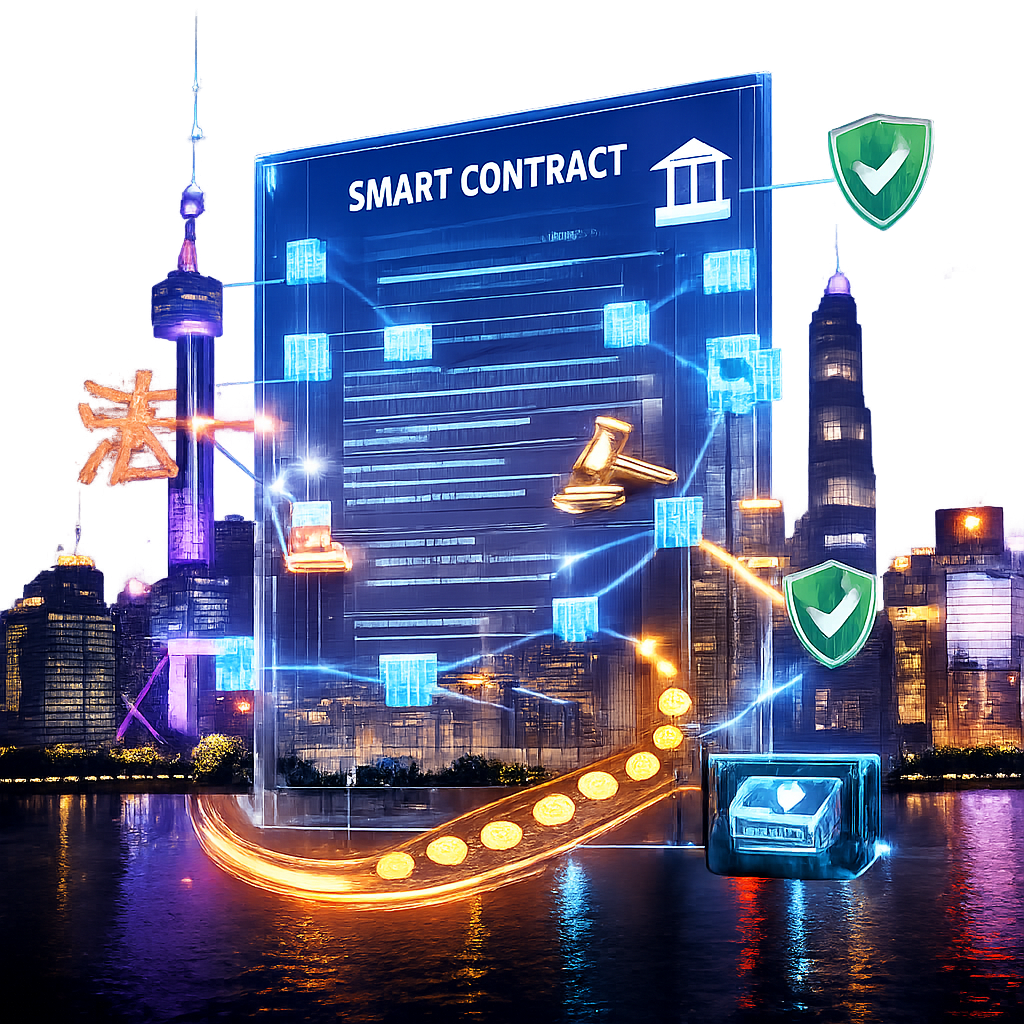
The Supreme People’s Court has acknowledged blockchain-based evidence in several high-profile cases, signaling openness to smart contract technology. However, enforceability depends on whether the coded terms align with Civil Code requirements for contract validity. A smart contract that automatically releases payment when goods reach a certain GPS coordinate might seem elegant technologically, but Chinese courts will still examine whether it satisfies legal requirements for clear acceptance, adequate consideration, and lawful object.
Technical reliability becomes a legal issue under Chinese contract law. If smart contract code contains bugs that cause unintended execution, who bears the loss? The Civil Code’s provisions on mistake, fraud, and force majeure could potentially apply, but case law remains underdeveloped. AI negotiation systems generating smart contract terms must ensure technical specifications are precise enough to avoid ambiguity while maintaining flexibility for scenarios the code can’t perfectly capture.
Data integrity and security take on heightened importance in China’s regulatory environment. The Personal Information Protection Law and Data Security Law impose strict requirements on how contract data—especially information about parties, prices, and performance—can be stored and transmitted. Smart contracts on public blockchains might conflict with data localization requirements. AI systems must generate terms addressing these regulatory constraints explicitly.
For procurement teams looking to integrate AI negotiation tools into their China supplier relationships, practical implementation requires thoughtful staging. Start with high-volume, low-risk contracts where AI can prove value quickly without exposing the business to catastrophic downside. Standard purchase orders, routine component procurement, and repetitive service agreements offer ideal testing grounds. These scenarios let your team build confidence in the technology while establishing protocols for human oversight.
Ensure AI outputs satisfy PRC formality rules from the outset. The system should automatically include required elements like party identification details matching business registration documents, precise subject matter descriptions using China-specific terminology, clear price and payment terms denominated appropriately, and performance timelines accounting for Chinese statutory holidays and customs clearance procedures. Many AI contract tools trained primarily on Western agreements generate terms that seem complete but lack elements Chinese courts expect.
Maintain a human-in-the-loop for final assessments, particularly on clauses addressing dispute resolution, intellectual property, and termination. These provisions carry disproportionate weight when problems arise, and their interpretation under Chinese law often hinges on subtle factors AI systems still struggle to fully evaluate. Your experienced negotiator should review AI-generated terms against China-specific checklists before finalization.
Risk management and governance strategies must evolve alongside AI adoption. Data quality determines AI performance—garbage in, garbage out applies ruthlessly to contract negotiation systems. Invest in cleaning and structuring your historical contract data, supplier performance records, and market intelligence before expecting AI to deliver meaningful insights. Incomplete or inconsistent data will produce unreliable negotiation recommendations that could expose you to greater risk than manual processes.
Transparency and auditability become critical for compliance and quality control. Your AI system should document its reasoning for key recommendations: Why did it suggest this penalty clause? What data supported that price benchmark? Which risk factors triggered the compliance alert? This legal data analytics approach transforms compliance from reactive guesswork into systematic risk management. This audit trail protects you legally and operationally—demonstrating reasonable care if disputes arise, while helping your team identify when AI recommendations should be overridden.
Security and privacy protections must reflect China’s stringent regulatory environment. Contract data often contains sensitive commercial information subject to trade secret protections under Chinese law. Supplier information might include personal data of business contacts protected by PIPL. Your AI negotiation platform must implement appropriate technical and organizational measures—encryption, access controls, data minimization—to comply with Chinese data protection obligations.
Legal compliance mapping ensures AI-generated terms align with PRC contract law requirements. Build validation checks into your workflow: Does the proposed warranty clause satisfy Civil Code Article 617’s requirements? Do the payment terms comply with foreign exchange regulations? Does the IP ownership provision account for China’s first-to-file trademark system? Automated compliance screening catches issues before they become expensive mistakes.
Deploying AI in contract negotiations follows a predictable progression through implementation phases. Initial integration focuses on AI-assisted analysis—using the technology to review supplier proposals, flag risks, and suggest improvements to human-drafted terms. This phase builds team familiarity and identifies gaps in your data or workflows. Mid-stage deployment shifts to AI-generated drafts with human refinement, where the system creates initial contract versions your team then customizes and approves. Advanced implementation enables AI-to-AI negotiation for appropriate scenarios, with humans monitoring and intervening only when parameters are exceeded.
Change management deserves as much attention as technology selection. Your procurement team must understand how AI augments rather than replaces their expertise. Training should emphasize interpreting AI recommendations critically, recognizing system limitations, and knowing when human judgment must override algorithmic suggestions. Create clear escalation protocols defining which contract terms require senior review regardless of AI confidence levels.
Metrics for success should balance efficiency gains against quality outcomes. Track cycle time reductions—how much faster do negotiations conclude with AI assistance? Monitor cost savings achieved through better terms and reduced legal spend. Measure quality indicators like contract dispute rates, supplier performance improvements, and compliance incidents. The goal isn’t just faster negotiations; it’s better agreements that actually protect your interests under Chinese law.
Emerging trends point toward increasingly sophisticated AI negotiation capabilities. Natural language processing advances enable AI systems to understand contextual nuances and cultural factors that previously required human expertise. Machine learning models trained on millions of China-specific contracts develop intuition about which terms suppliers will accept, which require compromise, and which justify walking away. Integration with regulatory databases allows real-time compliance checking against China’s evolving legal framework.
The transformative potential of AI in contract negotiation aligns perfectly with iTerms AI Legal Assistant’s philosophy of bridging international businesses with China’s legal landscape through advanced AI solutions. When procurement teams combine deep China legal expertise with cutting-edge AI technology, they gain unprecedented ability to negotiate agreements that are simultaneously commercially advantageous and legally sound under PRC law.
The old way of negotiating with Chinese suppliers—manual, slow, information-asymmetric, legally uncertain—is giving way to AI-powered approaches that level the playing field. Foreign business owners no longer need to navigate China’s complex contract environment blind or accept unfavorable terms because they lack local knowledge. Smart technology surfaces the intelligence needed for confident negotiation while ensuring every agreement satisfies Chinese legal requirements. The result isn’t just faster deals—it’s protection against the million-dollar headaches that come from contracts that fail when you need them most. That’s the power of AI contract negotiation, and it’s available now to businesses ready to modernize their China supplier relationships.