
When an Australian manufacturing company signed its first supply contract with a Guangdong factory in 2022, everything looked perfect on paper. The contract terms seemed fair, the factory had impressive credentials. Six months later, the company discovered that same factory had 47 unresolved labor disputes, 12 environmental violations, and a pattern of IP theft allegations—all documented in public Chinese legal databases never knew existed. The contract signed contained dispute resolution clauses that had failed in 89% of similar cases. By the time problems surfaced, the company had already invested $2.3 million.
This scenario repeats itself across China every day, not because businesses lack legal advice, but because they operate without legal data analysis. In a market where regulatory databases hold over 120 million court judgments and thousands of daily regulatory updates, flying blind isn’t just risky—it’s financially reckless.
Legal data analysis (LDA) in China represents a fundamental shift from reactive legal advice to predictive risk intelligence. For foreign business owners establishing operations, expatriates securing property rights, international legal professionals advising on cross-border transactions, and global corporations managing China supply chains, LDA transforms opaque legal uncertainty into quantifiable risk patterns. This isn’t about reading laws; it’s about reading the reality of how those laws actually play out in Chinese courts, regulatory enforcement actions, and commercial disputes.
The question isn’t whether legal risks exist in China—everyone knows they do. The question is whether you’ll discover those risks through expensive litigation or through data analysis that reveals them before you sign, before you invest, before problems strike.

The Data Sources That Power Legal Intelligence
China’s legal data ecosystem contains more publicly accessible judicial information than most Western jurisdictions, yet remains vastly underutilized by international businesses. The primary source, China Judgments Online, contains over 120 million court decisions dating back to 2014, covering everything from contract disputes to IP infringement cases. This database publishes approximately 30,000 new judgments daily, creating a real-time map of how Chinese courts actually interpret and apply laws.
Beyond court decisions, the Supreme People’s Court maintains specialized case databases covering typical cases, guiding cases that establish judicial precedent, and administrative enforcement decisions. Provincial and municipal courts publish local enforcement patterns, revealing significant regional variations in how identical laws produce different outcomes. When a Beijing court interprets “reasonable compensation” in a trademark case, it might award 15 times what a Chongqing court grants under identical circumstances.
Regulatory publications add another critical layer. The State Administration for Market Regulation publishes enforcement actions against companies for antitrust violations, false advertising, and consumer protection breaches. The Cyberspace Administration of China details data security violations and cross-border data transfer penalties. Ministry of Commerce records track foreign investment approvals, rejections, and conditional clearances, revealing patterns in what triggers regulatory scrutiny.
For businesses evaluating potential Chinese partners, the National Enterprise Credit Information Publicity System provides corporate registration details, administrative penalties, court judgments, and abnormal operation listings. Cross-referencing this system with judicial databases reveals companies that appear compliant on paper but face mounting legal liabilities.
The Shanghai Stock Exchange and Shenzhen Stock Exchange publish detailed litigation disclosures from listed companies, offering insights into emerging legal risks before they become industry-wide problems. When three major e-commerce platforms simultaneously face consumer protection lawsuits over identical algorithmic practices, it signals an enforcement trend that will soon affect all digital platforms.
These sources collectively generate billions of data points annually. The raw material exists; what most international businesses lack is the analytical infrastructure to transform that material into actionable intelligence.
The Challenge of Turning Data Into Intelligence
Accessing Chinese legal data presents immediate practical obstacles. Many databases require Chinese corporate registration to access full content. Others provide search functionality designed for Chinese legal professionals fluent in specialized terminology and procedural concepts that don’t translate directly to common law frameworks. The language barrier isn’t just about translation—it’s about understanding that “合同无效” (contract invalidity) encompasses six distinct legal concepts that Western contracts would treat separately.
Completeness remains inconsistent. While Supreme People’s Court cases receive reliable publication, lower court decisions face selective disclosure. Courts can withhold judgments involving state secrets, commercial confidentiality, or sensitive subjects. Some provincial courts publish 90% of their decisions; others publish less than 50%. This creates data gaps that require sophisticated inference techniques to address.
Timeliness varies dramatically. A landmark Supreme People’s Court interpretation might appear in databases within days, while lower court judgments can take six months to publish. For businesses negotiating contracts or evaluating partners, a six-month data lag means operating with outdated risk assessments. By the time negative judgments appear publicly, companies may have already committed to agreements with problematic counterparties.
Structured versus unstructured data poses another challenge. While some databases offer structured search fields for case types, parties, and dates, the actual legal reasoning sits in unstructured judicial opinion text. Extracting meaning from these opinions requires natural language processing (NLP) systems specifically trained on Chinese legal terminology, procedural frameworks, and judicial reasoning patterns. Standard machine translation tools fail catastrophically because they translate words without understanding legal concepts—turning “good faith” obligations into “good letter” requirements.
Knowledge-enhanced language models address this problem by integrating legal domain expertise into AI systems. These models understand that when a Beijing IP court cites Article 59 of the Trademark Law in a case involving foreign brands, it signals specific evidentiary requirements that differ from how Shanghai courts apply the same article. They recognize that “substantial similarity” in copyright cases has evolved differently across artistic domains, with software cases applying stricter standards than musical works.
The regulatory context complicates data access further. China’s Personal Information Protection Law (PIPL), enacted in November 2021, restricts how companies can collect, store, and cross-border transfer data that includes personal information—which encompasses parties’ names, corporate representatives, and contact details in court judgments. The Cybersecurity Law requires critical information infrastructure operators to store collected data within China, affecting how international businesses access and utilize Chinese legal databases.
The Data Security Law, effective September 2021, classifies data into general, important, and core categories, with important data facing export restrictions unless security assessments approve transfer. Legal research data containing enforcement patterns or regulatory trends may qualify as important data, requiring complex compliance procedures before international businesses can integrate it into their risk management systems.
These regulatory frameworks don’t prohibit legal data analysis—they mandate compliant approaches. Businesses must anonymize personal information, obtain proper authorization for data transfers, conduct security assessments, and maintain Chinese data storage infrastructure. For global corporations, this means building localized legal intelligence capabilities within China rather than centralizing all analysis in headquarters.
From Raw Data to Risk Scores
Effective legal data analytics follows a structured methodology that transforms millions of judicial records into decision-ready intelligence. Data acquisition begins with systematic collection from multiple sources, using API integration where available and web scraping for databases lacking structured access. Collection must track data provenance, ensuring each judicial opinion links back to its verified source and publication date.
Data cleaning addresses inconsistencies, duplications, and formatting irregularities. Court records might list party names in multiple formats—”苹果公司” versus “Apple Inc.” versus “苹果电脑贸易(上海)有限公司”—requiring entity resolution algorithms that recognize these represent related entities. Dates appear in mixed formats across databases, needing standardization before chronological analysis becomes possible.
Feature extraction identifies legally meaningful patterns within unstructured opinion text. Advanced NLP systems extract parties’ identities, causes of action, key facts, legal reasoning, holdings, and remedies awarded. For contract disputes, feature extraction identifies contract types, disputed clauses, breach categories, and whether courts enforced or invalidated specific provisions. For IP cases, it captures infringement types, damages calculations, and evidentiary standards courts applied.
Jurisdictional pattern analysis reveals how legal outcomes vary across China’s geographic and economic landscape. A foreign investor evaluating warehouse locations needs to know that logistics contract disputes in Zhejiang Province result in plaintiff victories 67% of the time, while identical disputes in Henan Province favor plaintiffs only 41% of the time. This isn’t about better lawyers—it’s about different judicial cultures, local protectionism patterns, and regional economic priorities.
Temporal trend analysis tracks how enforcement priorities shift over time. Between 2020 and 2024, data privacy violations saw penalties increase 340% on average, with cross-border data transfer cases specifically facing 520% higher fines. Employment disputes involving algorithm-managed workers jumped from 300 cases in 2020 to over 8,000 in 2024, signaling an emerging high-risk area for platform economy businesses.
Predictive modeling applies machine learning algorithms to historical outcomes, generating probability distributions for case outcomes based on specific fact patterns. When a foreign e-commerce platform faces consumer protection allegations involving misleading product descriptions, predictive models can estimate likelihood of administrative penalties, expected fine ranges, and probability of criminal referral based on how regulators treated 2,847 comparable cases.
Risk scores aggregate multiple risk dimensions into quantifiable metrics. A potential Chinese manufacturing partner might receive overall risk score of 68/100, breaking down into contract performance risk (45/100 based on 12 contract breach cases), IP risk (82/100 based on 5 trademark disputes), and regulatory compliance risk (71/100 based on 3 environmental violations). These scores enable direct comparisons across potential partners and objective threshold-setting for due diligence triggers.
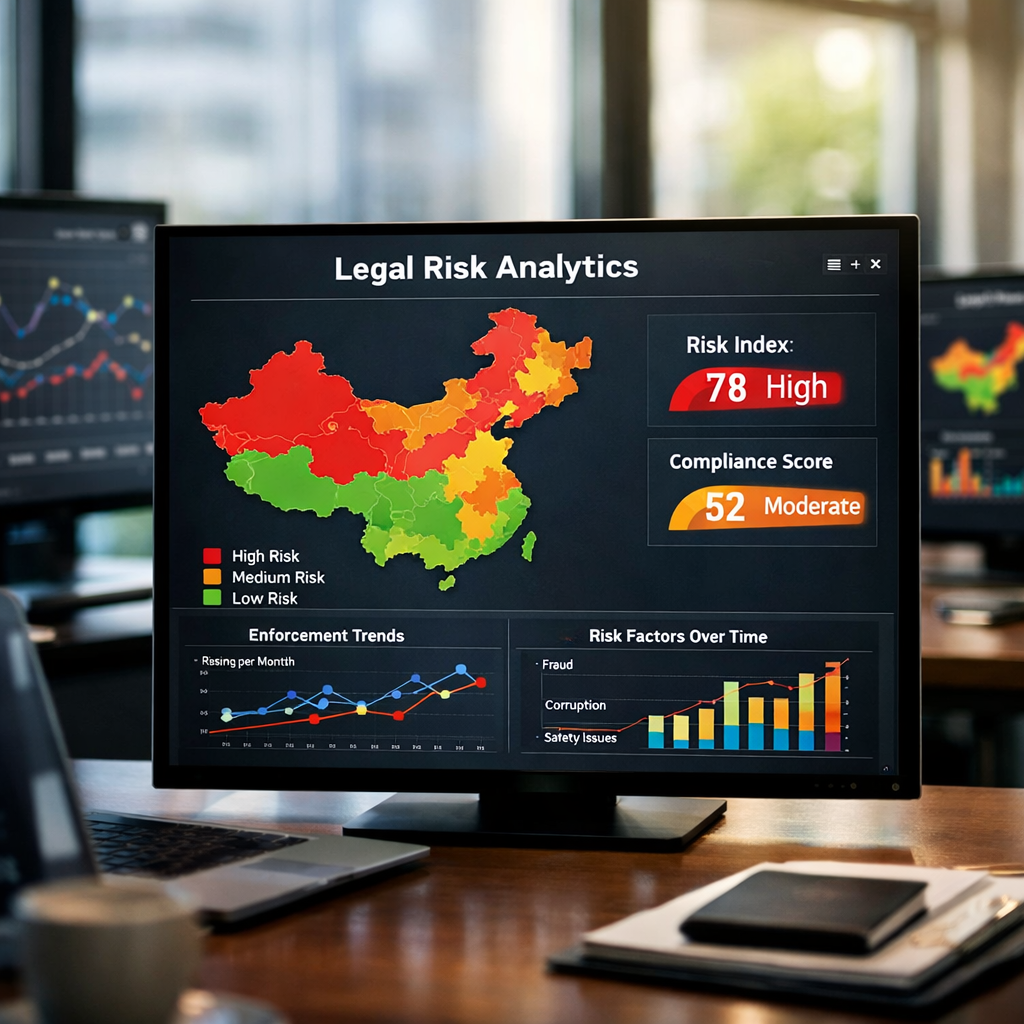
Dashboard deployment makes analytics accessible to non-technical decision makers. Interactive visualizations show risk trends over time, geographic heat maps of enforcement patterns, and counterparty-specific risk profiles. When a compliance officer searches for “labor dispatch violations in manufacturing sector,” the dashboard returns real-time statistics on violation frequency, penalty ranges, and correlation with other compliance failures.
Putting Legal Data Analysis to Work
Due diligence for foreign investments demonstrates legal data analysis’ most immediate value. Traditional due diligence reviews corporate registration documents, financial statements, and major contracts—backward-looking snapshots of what companies report about themselves. Legal data analysis adds forward-looking litigation risk intelligence and regulatory violation patterns that companies don’t voluntarily disclose.
When a European automotive parts supplier evaluated a potential Chinese joint venture partner in 2023, traditional due diligence showed clean financials and valid licenses. Legal data analysis revealed the target company’s three affiliated entities had 23 ongoing environmental violation cases, 9 labor disputes involving unpaid social insurance, and 4 instances where courts ruled against them for contract fraud. Analysis of their contract dispute history showed a concerning pattern: they aggressively enforced contracts when they held superior bargaining positions but frequently contested unfavorable terms through litigation. The deal proceeded with substantially modified terms protecting the European investor’s interests.
Compliance program design benefits enormously from understanding real enforcement patterns rather than theoretical legal requirements. China’s Anti-Unfair Competition Law prohibits commercial bribery, but penalties vary dramatically based on bribery context. Legal data analysis of 1,200+ commercial bribery cases shows that healthcare industry bribes face criminal prosecution 78% of the time, while similar conduct in business services triggers criminal charges only 31% of the time. Average administrative fines for healthcare bribes are 6.2 times higher than business services cases. This intelligence enables pharmaceutical companies to allocate compliance resources proportionally to actual enforcement intensity.
Regulatory monitoring through legal data analysis provides early warning of shifting enforcement priorities. In late 2022, data analysis detected a 340% increase in tax investigation notices issued to foreign-invested consulting firms, concentrated in Beijing and Shanghai. Six months before this trend gained industry awareness, legal data analysis identified it as a systematic enforcement initiative targeting specific service models. Companies using similar structures had time to conduct internal reviews and adjust their operations before investigations reached them.
Contract negotiation gains strategic advantage from understanding which clauses Chinese courts actually enforce. A common mistake Western businesses make is including elaborate liquidated damages provisions that Chinese courts routinely reduce as “excessive.” Analysis of 3,400 contract disputes involving liquidated damages shows courts reduce agreed amounts in 73% of cases, cutting them to an average 47% of the contractual figure. Rather than waste negotiation capital on provisions courts won’t enforce, sophisticated businesses focus on crafting dispute resolution clauses that analysis proves effective. Arbitration clauses specifying CIETAC Shanghai with seated arbitration in Singapore show a 91% enforcement rate, while clauses calling for litigation in home country courts face 67% refusal of jurisdiction.
Employment disputes benefit from understanding regional variation in judicial attitudes. Shanghai courts grant employee requests for overtime pay in 82% of cases where employees present communication records showing after-hours work, while Shenzhen courts grant similar claims only 51% of the time under virtually identical facts. For multinational employers establishing Chinese operations, this intelligence directly impacts location decisions for headquarters functions versus manufacturing facilities.
The Path Forward: Integration and Action
Legal data analysis works best when integrated with internal business intelligence. Public legal databases reveal market-wide patterns; internal contract performance data, supplier compliance records, and employee incident reports add company-specific context. A logistics company operating across China should combine public data showing regional contract enforcement patterns with internal data tracking which provinces generate the most delivery disputes, payment delays, and operational issues.
Cross-functional collaboration multiplies data analysis value. Legal teams identify which legal questions matter most for business decisions; data science teams build analytical models answering those questions; business units contribute operational insights that refine model relevance. When procurement teams evaluate new suppliers, they shouldn’t just check whether legal analysis flags risks—they should contribute transaction-specific parameters that contextualize those risks for their particular use case.
⚡ Continuous monitoring beats point-in-time analysis. Legal risk isn’t static. A factory with clean compliance history can accumulate violations within months. Regulatory priorities shift quarterly. Establishing automated monitoring systems that alert stakeholders when counterparties accumulate new judgments, when enforcement patterns shift in relevant industries, or when regulatory changes materially affect operations transforms legal data analysis from a project into a capability.
The fundamental insight legal data analysis provides is this: China’s legal system operates with more transparency than most international businesses realize, but that transparency exists in forms requiring sophisticated analytical approaches to access. Court judgments, regulatory enforcement records, and administrative decisions collectively reveal how laws work in practice, which courts favor which interpretations, where regulatory scrutiny concentrates, and what compliance failures trigger serious consequences versus warnings.
At iTerms AI Legal Assistant, we’ve built our platform precisely because legal data analysis in China has transitioned from optional competitive advantage to essential risk management. The legal frameworks governing China business operations have grown more complex, enforcement has intensified across multiple regulatory domains, and the cost of compliance failures has escalated dramatically. Simultaneously, the data necessary to navigate this environment has become more accessible—if you have the tools to transform that data into intelligence.
The hidden map revealing your real China business risk isn’t hidden because Chinese authorities conceal it. It’s hidden because extracting meaningful patterns from 120 million court decisions, thousands of daily regulatory updates, and constantly evolving enforcement priorities requires combining legal expertise with advanced AI capabilities specifically designed for Chinese legal contexts.
Before you sign your next China contract, establish a new operation, or commit significant investment, the question isn’t whether legal risks exist—it’s whether you’ll discover them through analysis or experience. Legal data analysis provides the map. Whether you use it before problems strike is your decision.