
Picture this: A Seattle-based tech startup lands its first major Chinese client. The founders celebrate with champagne, thrilled about entering the world’s second-largest economy. Six months later, they’re sitting across from a stern-faced official explaining why their customer data handling violates three separate Chinese laws they’d never heard of. The penalty? Potentially millions in fines and immediate suspension of operations.
This scenario plays out more often than you’d think. Foreign companies entering China often treat compliance as an afterthought—something to figure out “later” after they’ve established market presence. The problem? China’s regulatory environment doesn’t work that way. Unlike jurisdictions where businesses can operate in gray areas until specific violations occur, China requires proactive compliance frameworks from day one. The regulatory knock isn’t a warning—it’s an enforcement action.
Understanding why compliance matters in China isn’t just about avoiding fines. It’s about operational survival. China’s legal system operates on the principle of administrative supervision, meaning regulators actively monitor rather than passively respond. For foreign businesses, this means your compliance posture is constantly under scrutiny, whether you realize it or not.
Navigating China’s Interlocking Regulatory Maze
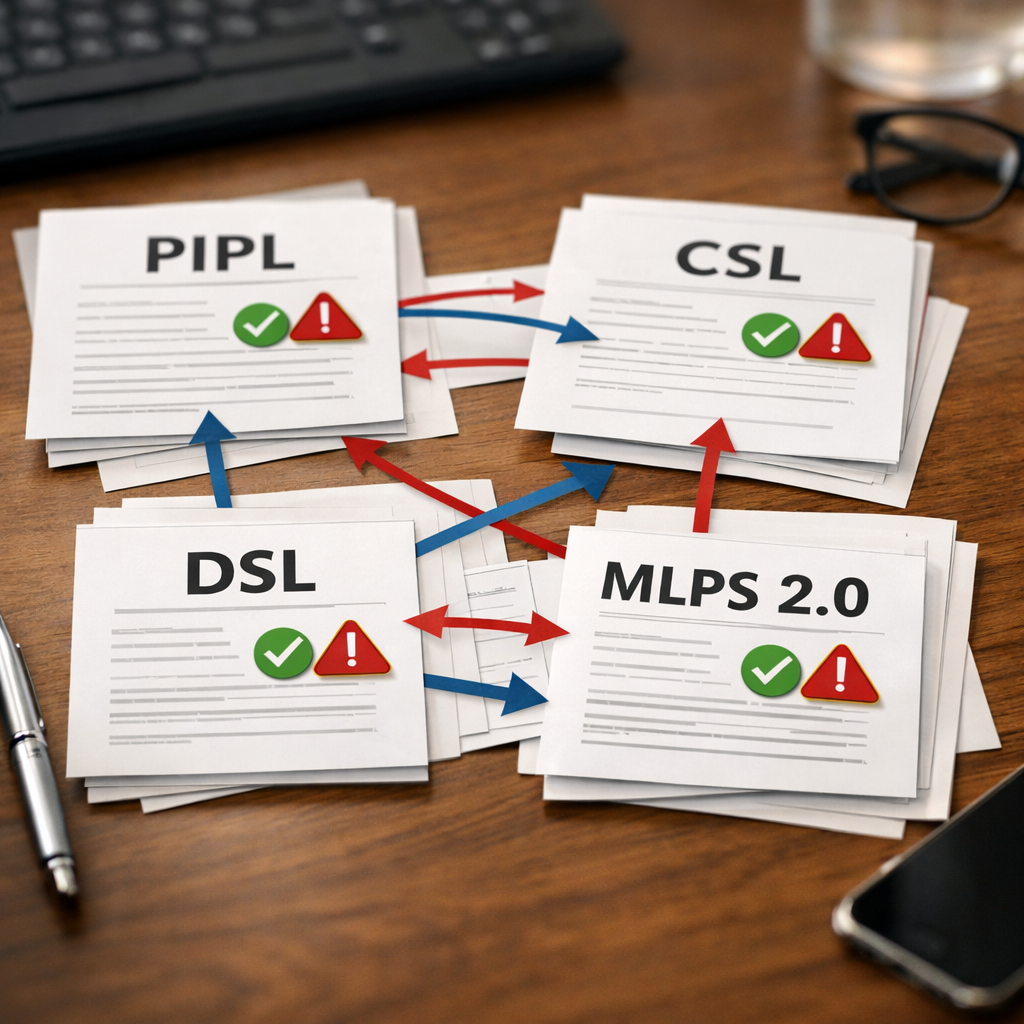
China’s data protection and cybersecurity regulatory landscape resembles a complex puzzle where every piece connects to multiple others. At the center sit four major legal frameworks that foreign companies must navigate simultaneously: the Personal Information Protection Law (PIPL), Cybersecurity Law (CSL), Data Security Law (DSL), and Multi-Level Protection Scheme (MLPS 2.0).
The PIPL, often called China’s GDPR, took effect in November 2021 and governs how organizations collect, store, use, and transfer personal information. But here’s where it gets tricky—the PIPL doesn’t exist in isolation. It works in tandem with the CSL, which focuses on network security and critical information infrastructure protection, and the DSL, which establishes data classification and protection obligations based on importance to national security and economic development.
Then there’s MLPS 2.0, a comprehensive cybersecurity protection scheme that requires organizations to classify their information systems into five security levels and implement corresponding security controls. Think of it as the operational backbone that enforces the requirements set by the three major laws.
What makes this framework particularly challenging for foreign companies is the concept of jurisdictional reach. These laws apply not just to companies physically located in China, but to any organization processing personal information of individuals within China’s territory or offering products and services to Chinese users. A company headquartered in Frankfurt that never sets foot in China but serves Chinese customers through its app? Still covered.
The interplay between these laws creates compliance obligations that compound rather than simply add up. For instance, cross-border data transfers trigger requirements under all three major laws simultaneously—the PIPL demands individual consent and security assessments, the CSL requires critical infrastructure operators to store data locally, and the DSL mandates protection measures based on data classification. Miss any piece, and your entire compliance framework crumbles.
The 14-Step Roadmap: Building Compliance That Actually Works
Most foreign companies approach China compliance like assembling furniture without instructions—they tackle whatever piece seems urgent while missing the structural foundation. Here’s the methodical roadmap that separates compliant operations from regulatory nightmares:
Step 1: Secure Executive Sponsorship and Budget Allocation
Compliance isn’t an IT project or a legal checkbox. It requires C-suite commitment and dedicated resources. Designate a compliance officer with direct reporting lines to executive leadership and secure a realistic budget that accounts for ongoing monitoring, not just initial setup.
Step 2: Conduct Comprehensive Business Activity Mapping
Document every business process that involves data collection, processing, storage, or transmission. This includes obvious activities like customer registrations and hidden ones like employee email systems or third-party analytics tools. Foreign companies consistently underestimate the scope of their data activities.
Step 3: Perform Data Asset Discovery and Classification
Identify what data you actually hold, where it resides, and how it moves through your systems. Apply China’s data classification framework: personal information, sensitive personal information, important data, and core data. Each category triggers different protection obligations under the DSL.
Step 4: Map Cross-Border Data Flows
Document every instance where data crosses China’s borders—cloud backups to overseas servers, consolidated reporting to headquarters, third-party service providers in other jurisdictions. These transfers are highly regulated and often require security assessments or government approvals.
Step 5: Assess MLPS 2.0 Level Requirements
Determine which MLPS level applies to your information systems based on their importance and potential harm if compromised. Most foreign companies operating in China fall under Level 2 or 3, each requiring specific technical controls and regular security assessments.
Step 6: Establish Legal Basis for Data Processing
For every data processing activity, identify your legal basis under PIPL—typically consent, contractual necessity, or legal obligation. The “consent” route that works in other jurisdictions requires much more rigorous standards in China: clear, informed, voluntary, and specific to each processing purpose.
Step 7: Implement Privacy-by-Design Architecture
Rebuild data collection and processing systems with compliance built into their core design. This means data minimization (collect only what’s necessary), purpose limitation (use data only for stated purposes), and automated consent management. Retrofitting compliance into existing systems rarely works and creates ongoing vulnerabilities.
Step 8: Develop Data Localization Strategy
Identify what data must stay in China under CSL Article 37 (critical information infrastructure operators’ data and personal information) and DSL requirements. Set up compliant local storage infrastructure or cloud partnerships with providers holding appropriate Chinese licenses.
Step 9: Create Cross-Border Transfer Mechanisms
For data that legitimately needs to leave China, implement one of the three approved transfer mechanisms: security assessment by the Cyberspace Administration of China (CAC), standard contractual clauses, or certification by approved institutions. Each path has specific procedural requirements and approval timelines.
Step 10: Build Third-Party Vendor Management Framework
Foreign companies often overlook that they’re responsible for their vendors’ compliance. Establish due diligence processes for any third party that processes your data, including cloud providers, payment processors, marketing platforms, and HR systems. Verify their Chinese licenses, security certifications, and contractual compliance commitments.
Step 11: Implement Individual Rights Infrastructure
PIPL grants individuals significant rights: access, correction, deletion, portability, and withdrawal of consent. Build operational processes and technical systems to respond to these requests within the law’s 15-day deadline. Automated request handling isn’t optional at scale—it’s survival.
Step 12: Establish Incident Response and Reporting Protocols
Develop procedures for detecting, containing, and reporting personal information security incidents. PIPL requires notification to regulators and affected individuals “without undue delay” when incidents occur. Foreign companies frequently underestimate Chinese regulators’ expectations for transparency and speed.
Step 13: Deploy Ongoing Monitoring and Audit Systems
Compliance isn’t a one-time achievement—it’s a continuous state. Implement monitoring for policy violations, unauthorized data transfers, consent expiration, and system security. Schedule regular internal audits and third-party assessments to identify gaps before regulators do.
Step 14: Maintain Documentation and Record-Keeping
Chinese regulators expect comprehensive documentation proving compliance—data processing records, consent logs, security assessment reports, vendor agreements, training completion records. In enforcement actions, the burden of proof falls on companies to demonstrate compliance, not on regulators to prove violations.

The Steps Companies Skip (And Why They Pay for It)
Three compliance areas consistently trip up foreign businesses, usually because they assume practices acceptable in their home markets transfer to China:
Cross-Border Data Transfers: The Silent Compliance Killer
A European manufacturer consolidates operational data from its Chinese subsidiary to headquarters for financial reporting—standard practice globally, right? Not in China. That transfer likely triggers CAC security assessment requirements, which can take six months and require detailed disclosure of data security measures. Companies discover this when preparing for an audit or during a regulatory inspection, by which point they’ve been non-compliant for months or years.
The mistake isn’t the transfer itself—it’s assuming that legitimate business needs automatically justify it. In China’s regulatory framework, the government decides whether cross-border transfers serve acceptable purposes through the security assessment process. Foreign companies skip this step because they don’t realize it exists until faced with enforcement.
Data Localization: Beyond Just Servers in China
Companies hear “data localization” and think “we’ll rent Chinese servers.” But localization under Chinese law means much more: Chinese legal jurisdiction over the data, Chinese-licensed service providers, domestic disaster recovery systems, and restricted access from overseas locations. A foreign company using AWS China region might satisfy technical localization but still fail compliance if the architecture allows headquarters administrators to access the data directly.
The gap occurs because foreign companies treat localization as a technical requirement when it’s fundamentally a sovereignty requirement. China wants assurance that data important to its citizens and economy remains under Chinese legal and operational control.
Third-Party Vendor Management: Your Compliance Weak Link
A US e-commerce platform enters China and uses the same marketing analytics provider it uses globally. That provider collects behavioral data on Chinese users and processes it on US servers. The e-commerce platform views this as the vendor’s responsibility; Chinese regulators see it as the platform’s compliance failure.
Foreign companies consistently underestimate that PIPL makes them jointly liable for their processors’ compliance. You can’t outsource accountability. When your payment processor, cloud provider, or customer service platform violates Chinese data protection laws, you face the same penalties as if you’d committed the violation directly.
The Upside: What Proper Compliance Actually Buys You
Building a robust compliance framework isn’t just defensive—it creates strategic advantages that separate sustainable China operations from those constantly fighting fires.
Operational Security: A well-implemented compliance framework means you actually know what data you hold, where it lives, and who can access it. This visibility prevents data breaches, reduces insider threats, and speeds incident response. Foreign companies with mature compliance frameworks resolve security incidents in hours; those without can take weeks just to understand what happened.
Regulatory Confidence: When inspectors arrive (and in China, they will), documented compliance transforms an adversarial audit into a routine verification. Companies with compliance frameworks answer questions with evidence; those without scramble to explain gaps. The difference often determines whether you face enforcement action or continue operations.
Sustainable Growth: Every time China introduces new regulations—and the pace continues accelerating—compliant companies adapt through framework updates while non-compliant competitors face existential crises. Compliance becomes your competitive moat.
This philosophy of turning compliance into competitive advantage aligns perfectly with how iTerms AI Legal Assistant approaches China business challenges. Rather than viewing Chinese regulations as obstacles, iTerms recognizes them as the fundamental framework within which foreign businesses must operate successfully. The platform’s AI-powered legal solutions bridge the gap between international business practices and China’s regulatory requirements, providing the practical tools and knowledge that transform compliance from burden into business enabler.
iTerms’ bilingual legal comprehension doesn’t just translate words—it maps legal concepts between jurisdictions, helping foreign businesses understand not just what Chinese law requires, but why those requirements exist and how to satisfy them efficiently. The platform’s scenario-based guidance addresses the real decisions foreign companies face: Can we transfer employee data to our global HR system? What consent language satisfies PIPL requirements? How do we structure cloud architecture to meet both MLPS and data localization rules?
This practical, decision-focused approach recognizes that foreign businesses don’t need academic explanations of Chinese law—they need actionable intelligence that prevents mistakes before they become enforcement actions.
Your Compliance Investment: Now or Later (But Later Costs More)
Foreign companies face a fundamental choice when entering China: invest in compliance upfront or pay for it later through enforcement actions, operational disruptions, and missed opportunities. The math overwhelmingly favors the former.
Building a comprehensive compliance framework requires significant initial investment—budget for legal expertise, system modifications, process redesign, and ongoing monitoring. But that investment purchases operational predictability in a market where regulatory uncertainty can paralyze business decisions.
The alternative—operating in gray areas and hoping regulators don’t notice—carries catastrophic risks. China’s regulators don’t just fine non-compliant companies; they can suspend operations, block data transfers essential to business functions, and restrict market access. For foreign companies, these enforcement actions often spell exit from the Chinese market entirely.
Start with brutal honesty about your current compliance state. Most foreign companies discover they’re further from compliance than they realized once they understand the full scope of Chinese requirements. That discovery is painful but essential—you can’t fix what you don’t acknowledge.
Prioritize the compliance steps that address your highest-risk gaps first. Cross-border data transfers and lack of consent management top the list for most foreign businesses. Build your framework systematically rather than trying to achieve perfect compliance overnight—Chinese regulators recognize good-faith compliance efforts, but only if you can demonstrate actual progress.
Invest in compliance infrastructure that scales with your China operations. Your initial market entry might involve minimal data processing, but successful businesses quickly face expanded compliance obligations as they grow. Build systems that expand rather than needing complete replacement.
The companies thriving in China’s market aren’t those that ignore compliance or treat it as paperwork—they’re the ones that built regulatory navigation into their core operational DNA. They understand that compliance isn’t about restricting business activities; it’s about conducting those activities within the framework that Chinese law provides.
Your China business strategy either includes comprehensive compliance or includes an exit date. There’s no third option. The question isn’t whether to invest in compliance—it’s whether to invest before or after regulators force your hand. The 14-step roadmap provides the structure; your commitment determines the outcome.