
Picture this: It’s 3 AM, and you’re wide awake in your Shanghai hotel room, staring at your laptop screen. Your company’s annual compliance audit starts in two weeks, and you’ve just realized your team can’t locate half the required documentation. Your Chinese subsidiary’s financial records are scattered across three different systems, nobody’s quite sure if your data privacy protocols meet current PIPL requirements, and your local HR manager just informed you that several employment contracts might not be compliant with China’s latest labor regulations.
Sound familiar? If you’re nodding your head, you’re not alone. For foreign companies operating in China, compliance audits often feel like navigating a maze blindfolded—except the stakes involve potential fines, operational shutdowns, and serious reputational damage. The good news? With the right preparation strategy, you can transform this anxiety-inducing process into a manageable, systematic review that actually strengthens your China operations.
Let’s be honest: China’s regulatory environment isn’t just complex—it’s a living, breathing organism that evolves faster than most foreign companies can track. Between tax reforms, data security regulations, labor law updates, and industry-specific compliance requirements, staying audit-ready requires more than good intentions. It demands a structured, proactive approach that addresses every critical compliance dimension before auditors come knocking.
That’s where your 30-day compliance audit preparation checklist comes in—not as another bureaucratic burden, but as your strategic roadmap to regulatory peace of mind.
The Essential Components: Your 30-Day Compliance Audit Roadmap
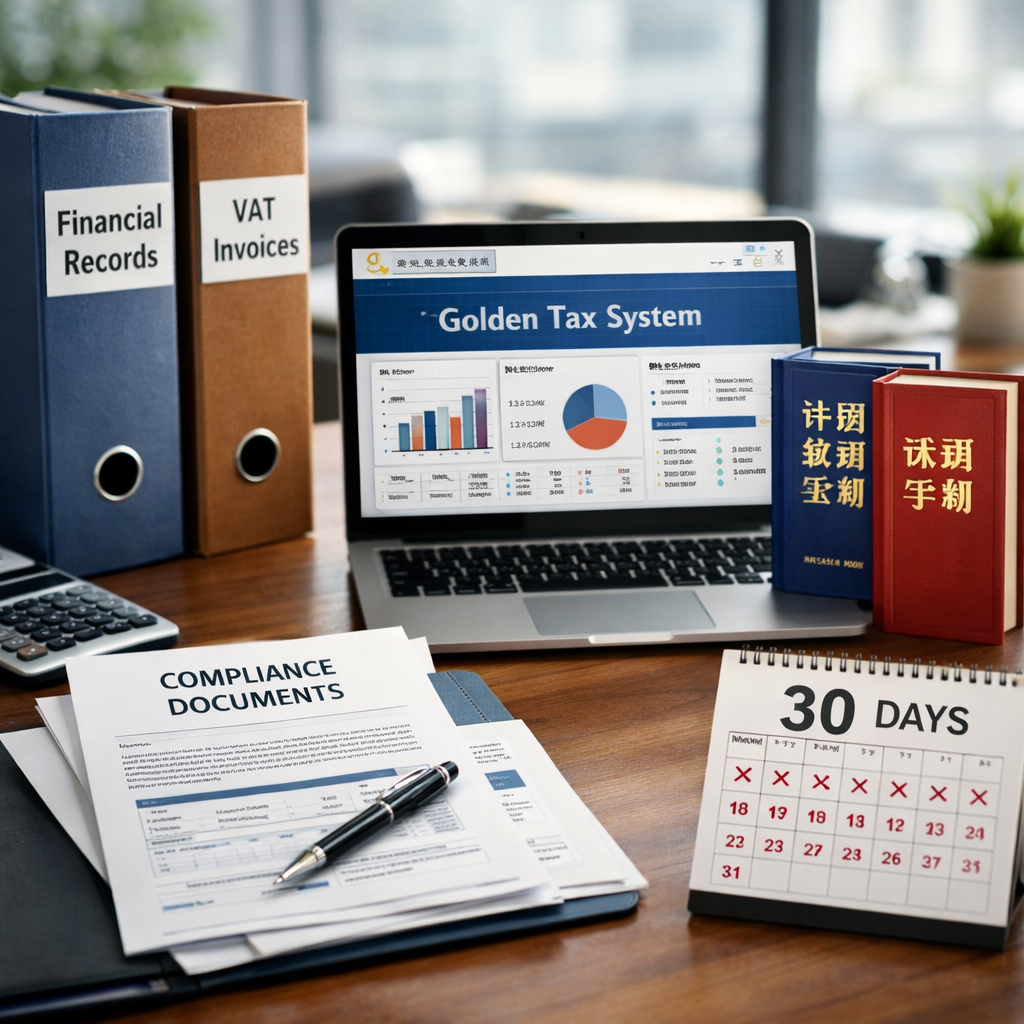
Days 1-7: Financial and Tax Alignment Review
Start with the foundation: your financial records and tax compliance status. Chinese authorities take financial transparency seriously, and auditors will scrutinize every yuan flowing through your operation.
Begin by consolidating all financial documentation from your Chinese entity—bank statements, VAT invoices (fapiao), payroll records, and intercompany transactions. Foreign business owners often underestimate how Chinese tax authorities cross-reference these documents. Every VAT invoice you’ve issued must match corresponding revenue entries. Every import declaration should align with your customs records and inventory management system.
Here’s what catches most companies off-guard: China’s Golden Tax System automatically flags discrepancies between reported revenue and issued invoices. If your sales revenue doesn’t match your VAT invoice records, expect detailed questioning during your audit. Review all export-import documentation, ensuring customs declarations align with your accounting records. For companies manufacturing in China, verify that your production materials, finished goods inventory, and export records tell a consistent story.
Tax withholding is another critical checkpoint. If you’re making payments to overseas entities—whether for services, royalties, or dividends—confirm that appropriate withholding taxes were collected and remitted. Many foreign companies discover during audits that they’ve inadvertently failed to withhold taxes on cross-border service payments, triggering penalties and back-tax assessments.
Days 8-14: Data Privacy and Security Compliance
China’s Personal Information Protection Law (PIPL) and Cybersecurity Law have fundamentally changed the compliance landscape for foreign companies. If your business processes Chinese customer data, employee information, or conducts any form of data analytics, this section of your audit preparation deserves serious attention.
Start by mapping your data flows. Where does personal information originate? How is it collected, processed, stored, and transmitted? For multinational companies, cross-border data transfers are particularly sensitive. If you’re sending Chinese user data, employee records, or business intelligence back to headquarters overseas, you need documented legal basis for these transfers—whether through Standard Contractual Clauses, obtaining explicit consent, or completing security assessments with China’s Cyberspace Administration.
Conduct an internal data compliance audit covering your entire data lifecycle. Review your privacy policies and user consent mechanisms. Chinese law requires clear, specific consent for personal information processing—buried consent clauses in lengthy terms of service won’t pass regulatory scrutiny. Examine your data security measures: encryption protocols, access controls, incident response procedures, and backup systems.
For foreign companies operating consumer-facing platforms or e-commerce operations in China, verify that your data localization practices comply with current requirements. Critical information infrastructure operators and large-scale personal information processors face stricter obligations, including mandatory security assessments and local data storage requirements.
Days 15-21: Corporate Governance and Documentation Readiness
Corporate governance documentation often seems like administrative housekeeping—until an auditor requests your company’s board meeting minutes from three years ago and you can’t produce them. Chinese corporate law requires maintaining comprehensive records of major business decisions, shareholder resolutions, and governance activities.
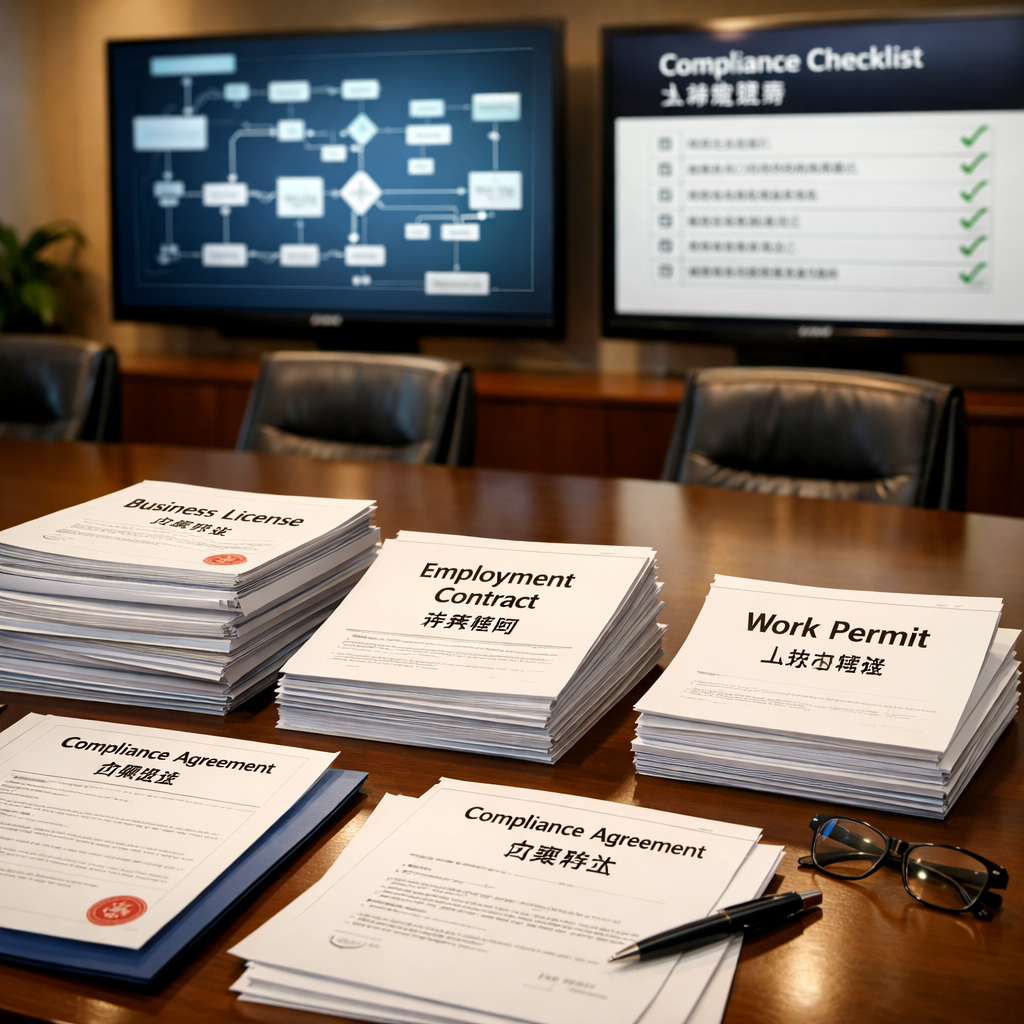
Start by assembling your corporate governance file: business license, articles of association, shareholder agreements, board meeting minutes, and all business scope changes since your company’s establishment. Foreign-invested enterprises must demonstrate that major decisions—capital increases, business scope expansions, significant asset transactions—followed proper approval procedures and were properly documented.
Employment compliance deserves particular attention. China’s labor laws are employee-protective, and auditors will examine whether your HR practices comply with mandatory requirements. Review all employment contracts, ensuring they include required clauses on compensation, working hours, social insurance, and termination conditions. Verify that your social insurance contributions (pension, medical, unemployment, work injury, and maternity insurance) plus housing fund payments are calculated correctly and paid timely for all employees.
Work permits and residence permits for foreign employees represent another critical checkpoint. Operating with expired work permits or employing foreigners without proper authorization can trigger immediate penalties. Compile a master list of all foreign staff, their permit expiry dates, and renewal timelines. If you’ve recently hired expatriates, confirm that their employment complies with China’s foreign talent classification system and that appropriate tax arrangements are in place.
Intellectual property documentation is equally important, especially for companies engaged in manufacturing, technology development, or brand-related activities in China. Gather all IP registration certificates, technology transfer agreements, licensing arrangements, and evidence of trademark/patent usage. If you’re collaborating with Chinese partners on R&D or product development, ensure your IP ownership and protection agreements are properly documented and registered with relevant authorities.
Days 22-28: Industry-Specific Compliance and Operational Permits
Industry-specific regulations often create the most complexity for foreign companies, as requirements vary dramatically across sectors. E-commerce companies face different obligations than manufacturing operations; fintech businesses operate under distinct rules from logistics providers.
Identify all industry-specific licenses and permits your operation requires, then verify their current status. Many permits require annual renewals or periodic reviews that companies overlook until audit time. Common examples include import-export licenses, food business permits, medical device registrations, telecommunications value-added service licenses, and product certifications.
For companies in regulated industries—healthcare, education, financial services, media—document your compliance with sector-specific rules. Healthcare companies should review their medical device registrations and pharmaceutical import licenses. Education providers must demonstrate compliance with foreign investment restrictions and curriculum approval requirements. Fintech operations need to show proper licensing for payment services or lending activities.
Product quality and safety compliance is non-negotiable for manufacturers and importers. Compile all product testing reports, quality certifications (CCC marking for relevant products), and safety documentation. If you’ve faced any quality complaints or product recalls, document the remediation actions taken and demonstrate improved quality control measures.
Environmental compliance increasingly appears in audit scope, particularly for manufacturing operations. Gather all environmental impact assessments, pollution discharge permits, and environmental monitoring reports. China’s environmental enforcement has intensified significantly, and auditors will verify that your operations meet current standards for emissions, waste management, and energy efficiency.
Days 29-30: Final Review and Mock Audit
Use your final two days to conduct an internal mock audit. Assign someone outside your core compliance team to review all documentation you’ve assembled, identifying gaps or inconsistencies. This fresh perspective often catches issues that your team has become blind to through familiarity.
Create a master index of all compliance documentation, organized by category and easily navigable. When auditors request specific documents, you should be able to locate them within minutes, not hours. Prepare executive summaries for complex areas—particularly useful for financial transactions, data processing activities, and governance decisions that require contextual explanation.
Brief all staff who might interact with auditors. Employees should understand what auditors are examining, know whom to direct specific questions to, and avoid volunteering unnecessary information. Appoint a single point of contact to coordinate auditor requests and ensure consistent communication.
Navigating Common Audit Challenges: Real Scenarios, Practical Solutions
Consider the case of a European manufacturing company that discovered during audit preparation that their Chinese subsidiary had been using a shared production facility with another entity without proper contractual documentation. The arrangement had developed organically over time for operational convenience, but created significant compliance ambiguity around cost allocation, tax treatment, and liability exposure. The company quickly formalized the arrangement through proper co-production agreements and equipment lease contracts, avoiding what could have been a major audit finding.
Another common challenge involves the “translation gap“—where English-language corporate policies don’t align with Chinese-language operational practices. A U.S. technology company learned this lesson when auditors discovered their employee handbook, HR policies, and non-compete agreements existed only in English, despite Chinese law requiring employment documents in Chinese language for enforceability. The company rushed to get proper translations done, but the discovery raised auditor concerns about overall compliance attentiveness.
Data privacy compliance often trips up companies that implemented systems before recent regulatory changes. An Australian e-commerce company operating in China faced scrutiny when auditors found their customer data processing practices hadn’t been updated since PIPL implementation. Their website’s privacy policy was outdated, consent mechanisms didn’t meet new specificity requirements, and cross-border data transfers lacked proper legal basis. The company needed to suspend certain data transmissions while implementing compliant processes—an operational disruption that proper preparation could have prevented.
For foreign companies navigating these complex requirements, traditional approaches of hiring local legal counsel for every question become prohibitively expensive and slow. This is precisely where integrated technology solutions transform compliance management from reactive crisis control to proactive risk mitigation.
iTerms AI Legal Assistant represents this new paradigm—a platform that combines deep China legal expertise with advanced AI capabilities to provide real-time, contextual guidance on compliance questions. Rather than waiting days for legal counsel to research your specific scenario, iTerms delivers immediate, actionable answers tailored to your situation. Need to verify whether your employment contracts meet current requirements? Upload them for AI-powered review highlighting potential compliance gaps. Uncertain whether your data transfer practices require CAC approval? Get scenario-specific guidance based on your actual data flows and business model.
The platform’s bilingual legal comprehension bridges the translation gap that frequently causes compliance issues, ensuring foreign companies understand not just what Chinese regulations say, but what they mean in practical application. For audit preparation, this means faster document review, clearer identification of compliance gaps, and more confidence that your preparation actually addresses regulatory expectations rather than just checking boxes.
Taking Control: Your Proactive Compliance Future
The difference between companies that treat compliance audits as periodic crises versus those that maintain continuous audit-readiness often comes down to systems and mindset. Reactive companies scramble when auditors schedule visits, frantically assembling documentation and discovering problems too late to fix properly. Proactive companies build compliance management into regular operations, treating audit preparation as an opportunity to strengthen their China business foundation.
This proactive approach means more than just following your 30-day checklist before scheduled audits. It means establishing year-round compliance monitoring that keeps critical documentation current, flags regulatory changes affecting your operations, and addresses gaps before they become audit findings. It means training your team to recognize compliance issues in daily operations—whether procurement decisions, customer data handling, or employment practices—and resolve them at the source.
Technology plays an enabling role in this transformation, but not as a replacement for legal judgment and business decision-making. Rather, AI-powered legal intelligence platforms like iTerms serve as force multipliers, extending your compliance capacity without proportionally increasing costs. They provide the real-time legal guidance that helps you make confident decisions quickly, while freeing your senior legal resources to focus on truly complex strategic issues rather than routine compliance questions.
For foreign business owners, this means running your China operations with greater confidence and less regulatory anxiety. For expatriates living in China, it means access to reliable legal guidance for both business and personal matters in a language and format that makes sense. For international legal professionals, it means having specialized China legal resources that enhance your ability to serve clients effectively. For global corporate clients, it means scalable, certified legal solutions that support growth without proportionally expanding legal department headcount.
The 30-day compliance audit checklist isn’t just about surviving your next audit—it’s about building the operational discipline and support systems that make China regulatory compliance manageable rather than mysterious. It’s about transforming compliance from a source of stress into a competitive advantage, demonstrating to partners, customers, and authorities that your company operates with professionalism and integrity in China’s complex business environment.
Start your checklist today, not when audit notices arrive. Build your documentation systematically, address gaps proactively, and leverage the technology and expertise that can streamline the entire process. Your future self—the one sleeping soundly the night before your audit begins—will thank you for the preparation. Because in China business, the companies that thrive aren’t necessarily those with the biggest legal budgets, but those with the smartest compliance strategies and the right tools to execute them effectively.