
For international businesses, China represents one of the world’s most lucrative markets. Yet between securing venture capital, negotiating with manufacturers, and planning your product launch, there’s a regulatory requirement that can stop your entire China operation before it begins: the China Compulsory Certification (CCC) mark.
The china regulatory ccc compliance mark isn’t just another bureaucratic formality—it’s a legal gatekeeper that determines whether your products can legally enter Chinese customs, sit on retail shelves, or be sold through e-commerce platforms. Much like the broader compliance challenges in China’s manufacturing sector, CCC certification represents a critical operational checkpoint that demands proactive planning. Without it, containers full of inventory can be held indefinitely at ports, manufacturing partnerships can collapse, and market entry timelines can extend by months or even years.
Understanding this certification isn’t about ticking compliance boxes. It’s about recognizing that China operates under a fundamentally different regulatory philosophy than Western markets, where product safety enforcement happens primarily at the point of certification rather than through post-market surveillance. The CCC system embodies China’s approach to consumer protection: prevent unsafe products from entering the market rather than removing them after incidents occur.

What the CCC Mark Actually Protects—And Controls
The China Compulsory Certification system was established in 2002 to replace multiple fragmented certification schemes with a unified national framework. At its core, the china regulatory ccc compliance mark ensures that products sold in China meet mandatory national standards for safety, health, environmental protection, and electromagnetic compatibility.
This certification covers 109 product types across 17 major categories as documented in the official 2024 CCC catalogue. The scope is deliberately broad, encompassing the electrical and electronic products that form the backbone of modern consumer and industrial markets. From the cables powering factory equipment to the laptops used in Shanghai offices, from automotive components to children’s toys—if it plugs in, connects, or poses potential safety risks, it likely requires CCC certification.
For foreign business owners, the practical impact is significant. That batch of industrial power adapters you’re importing? Requires CCC. The smart home devices your company manufactures in Shenzhen for domestic sale? Requires CCC. Even components within larger systems may need separate certification, meaning a single product line could require multiple CCC certificates.
The certification catalogue is not static. Chinese regulatory authorities regularly update which products require certification, often in response to emerging technologies or safety concerns. In 2024 alone, authorities announced pilot programs requiring QR codes on certain certified products and updated certification procedures for specific electrical equipment categories. What didn’t require certification last year might require it this year—a moving target that demands constant vigilance.
The consequences of non-compliance are blunt and immediate. Chinese customs will reject shipments lacking proper CCC certification—a reality that parallels the broader risks foreign businesses face during compliance audits. Retailers and e-commerce platforms refuse to stock uncertified products. Provincial and municipal market supervision authorities conduct regular inspections, and products found without required certification face seizure, substantial fines, and in severe cases, criminal liability for company executives.
The Certification Journey: More Complex Than It Appears
Obtaining CCC certification follows a structured but demanding process that typically spans 60 to 90 days under ideal conditions. In practice, delays from incomplete documentation, testing failures, or factory inspection issues commonly extend timelines to four or even six months.
The process begins with determining applicability. Not all products require CCC certification, and not all certification bodies can certify all product types. The Certification and Accreditation Administration of China (CNCA) maintains the official catalogue and accredits the testing laboratories and certification bodies authorized to grant CCC marks. Using non-accredited bodies or relying on agents who promise “faster” certification through unofficial channels is a critical mistake that leaves companies vulnerable to counterfeit marks and invalid certificates.
Once you’ve confirmed your product requires certification, the formal application process begins. You’ll submit detailed technical documentation—product specifications, circuit diagrams, component lists, quality system documentation—all in Chinese. This isn’t a translation formality; Chinese regulators expect documentation prepared according to Chinese technical standards and terminology, which often differ substantively from international equivalents.
Product testing forms the certification’s technical core. Samples must be sent to CNCA-accredited laboratories within China, where they undergo rigorous evaluation against relevant Chinese national standards (GB standards). These tests assess electrical safety, electromagnetic compatibility, environmental compliance, and product-specific requirements. Testing typically takes 4-6 weeks, assuming samples pass on the first attempt. Failures require modifications, new samples, and repeated testing, restarting the clock.
Factory inspections add another layer. Certification bodies conduct on-site audits of manufacturing facilities to verify that production processes can consistently deliver products meeting certified specifications. For foreign manufacturers, this means Chinese inspectors visiting your overseas facility or, more commonly, inspecting your Chinese manufacturing partner’s premises. The inspection examines quality control procedures, testing equipment, production consistency, and documentation systems. Non-conformities must be resolved before certification proceeds.
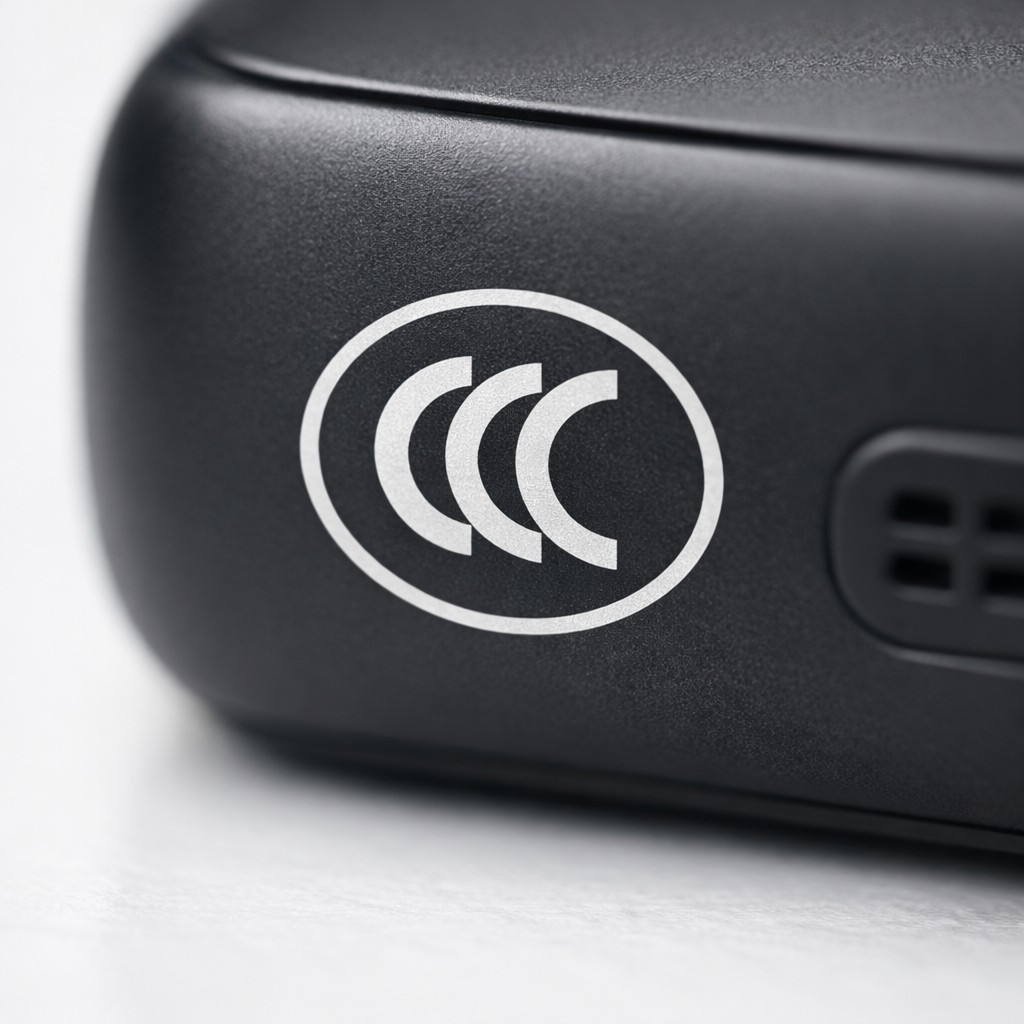
After successful testing and factory inspection, authorities issue the CCC certificate. But certification doesn’t end there. You must properly affix the CCC mark to products and packaging according to specific regulatory requirements regarding size, placement, and format. The mark must be permanent, clearly visible, and accompanied by the certification body’s identification code.
The Coming Traceability Revolution
Starting in July 2026, China will begin implementing a significant evolution in CCC compliance: mandatory QR codes on certified products. This pilot program, initially covering select product categories, transforms the china regulatory ccc compliance mark from a static symbol into a dynamic traceability tool.
Each QR code will link to a database containing the product’s certification information, manufacturing details, and compliance history. Consumers, regulators, and market participants will be able to instantly verify a product’s certification status by scanning the code. This move reflects China’s broader push toward digital governance and enhanced market supervision.
For businesses, this development carries profound implications. The QR code requirement creates new technical compliance obligations—products must accommodate the codes, packaging must be designed for easy scanning, and systems must be established to generate and track unique codes across production runs. More fundamentally, it increases transparency and accountability. Problems with certified products become more traceable to specific manufacturers and production batches, raising the stakes for quality control.
Certificate holders must begin converting existing simplified declaration of conformity (SDOC) certificates to traditional CCC certificates by July 2026, completing the transition before the system takes full effect. This isn’t merely administrative; it may require retesting, updated documentation, and renewed factory inspections depending on how long ago initial certification occurred.
The regulatory direction is clear: China is moving toward comprehensive digital traceability of certified products, and companies that delay adaptation will face costly last-minute scrambles or market exclusion.
Practical Guidance for Market Entry Success
For foreign business owners, expatriates, international legal professionals, and global corporate clients planning China market entry, understanding CCC compliance isn’t optional—it’s foundational to operational viability.
Start early. CCC certification timelines are measured in months, not weeks. Companies that treat certification as a final launch detail invariably encounter delays that cascade through entire business plans. Assess certification requirements during product development and market planning phases, not during shipment scheduling.
Engage reputable partners. The Chinese market contains numerous agents promising expedited certification or offering to navigate bureaucratic obstacles. Some are legitimate, experienced professionals; others traffic in counterfeit marks or fabricated certificates that create devastating legal exposure. Work only with CNCA-accredited certification bodies and licensed agents with verifiable track records. The cost of using legitimate channels pales compared to the cost of discovering invalid certification after you’ve invested in inventory, marketing, and distribution.
Prepare Chinese-language documentation properly. This isn’t about running technical manuals through translation software. Chinese regulatory authorities expect documentation prepared according to Chinese technical conventions, citing Chinese standards (GB standards), using Chinese regulatory terminology, and formatted according to Chinese administrative requirements. Partner with technical writers who understand both your products and Chinese regulatory expectations.
Build compliance into your manufacturing relationship. If you’re manufacturing in China, ensure your factory partner understands CCC requirements and has experience navigating certification processes. Include specific compliance obligations in manufacturing agreements, with clear allocation of responsibility for testing, inspections, and certificate maintenance. If manufacturing outside China, recognize that you’ll still need Chinese testing and likely need to establish relationships with Chinese certification bodies and agents.
Monitor regulatory changes continuously. The CCC system evolves regularly, with significant updates announced throughout 2024 affecting automotive and industrial categories. Product categories get added or removed, testing standards get updated, and procedural requirements change. Companies that obtain certification and then ignore updates risk non-compliance despite having valid certificates. Establish systems for tracking CNCA announcements, updates to the CCC catalogue, and changes in industry-specific requirements.
Don’t confuse CCC with other quality marks. China has various certification and quality marks—energy efficiency labels, environmental certifications, voluntary quality certifications. CCC is mandatory for covered products; obtaining voluntary certifications doesn’t satisfy CCC requirements. Similarly, international certifications like CE marking don’t substitute for CCC. Each regulatory system operates independently with distinct requirements and legal consequences.
The Real Business Decision
The china regulatory ccc compliance mark represents more than regulatory compliance—it’s a business intelligence test. Companies that master this certification demonstrate the broader competency needed for navigating China’s evolving regulatory landscape. Companies that understand CCC requirements demonstrate they’ve done serious homework about operating in China. They recognize that Chinese markets operate under different regulatory logic than Western markets, where the legal system emphasizes prevention over remediation and where certification precedes market access rather than following it.
For international businesses, this understanding translates into specific decisions:
Do you have 4-6 months of timeline buffer to absorb certification delays without derailing market entry? If not, your launch planning is unrealistic.
Do you have budget allocated for certification costs, testing fees, factory inspection expenses, and potential retesting? Certification costs vary by product complexity but typically range from several thousand to tens of thousands of dollars. Underfunding compliance is underfunding market entry.
Have you identified which specific Chinese national standards (GB standards) apply to your products? Generic awareness of “Chinese safety requirements” isn’t sufficient—you need precise knowledge of applicable technical standards to design compliant products from the outset.
Can you demonstrate that your manufacturing processes consistently produce products meeting certified specifications? CCC certification requires more than proving a sample passes tests; it requires proving your production system reliably delivers compliant products.
These aren’t hypothetical questions—they’re the practical decision points that determine whether your China market entry succeeds or stalls at the first regulatory checkpoint.
Moving Forward with Confidence
Navigating China’s regulatory landscape requires more than legal knowledge—it requires practical intelligence about how Chinese regulatory systems actually function, where foreign businesses commonly fail, and what specific steps prevent problems before they occur.
The CCC certification system embodies broader patterns in Chinese regulation: emphasis on ex-ante approval over ex-post enforcement, reliance on technical standards as regulatory instruments, integration of manufacturing oversight into product compliance, and increasing use of digital systems for regulatory supervision.
Success in this environment demands early assessment, knowledgeable partners, proper documentation, manufacturing coordination, and continuous monitoring. It requires seeing compliance not as bureaucratic burden but as operational prerequisite—the foundation on which everything else depends.
At iTerms AI Legal Assistant, we’ve built our platform specifically for international businesses and individuals facing these complex China legal landscapes. We understand that you need more than theoretical legal explanations—you need practical, scenario-led intelligence that helps you make confident decisions at each critical juncture.
Whether you’re evaluating if your products require CCC certification, navigating the certification process, ensuring compliance with upcoming QR code requirements, or addressing certification issues that have already emerged, the key is approaching compliance with clear understanding of Chinese regulatory logic and practical next steps tailored to your specific situation.
The china regulatory ccc compliance mark isn’t just another regulatory requirement to manage—it’s the hidden checkpoint that determines whether your China market entry proceeds smoothly or stops before it truly begins. Treat it accordingly.