
Picture this: It’s 2026, and you’re about to sign a manufacturing agreement with a Chinese supplier. Instead of waiting weeks for legal review, you receive a contract drafted by AI in hours—complete, compliant, and ready for negotiation. This isn’t science fiction. It’s the reality unfolding right now in China’s legal landscape.
As artificial intelligence reshapes how businesses operate in China, a fundamental question emerges: Are you prepared for a world where robots draft your contracts? For foreign business owners, expatriates, and international legal professionals, understanding this transformation isn’t optional—it’s essential for survival in the Chinese market.
China’s integration of AI into legal services represents more than technological novelty. It reflects a strategic national priority. Beijing’s current five-year plan positions artificial intelligence as a central pillar of digital transformation across industries, including legal services. Goldman Sachs Research estimates that generative AI will begin raising China’s potential growth by 2026, providing a 0.2-0.3 percentage point boost to GDP. This isn’t distant speculation—it’s happening now, and it’s reshaping how contracts are written, reviewed, and enforced.
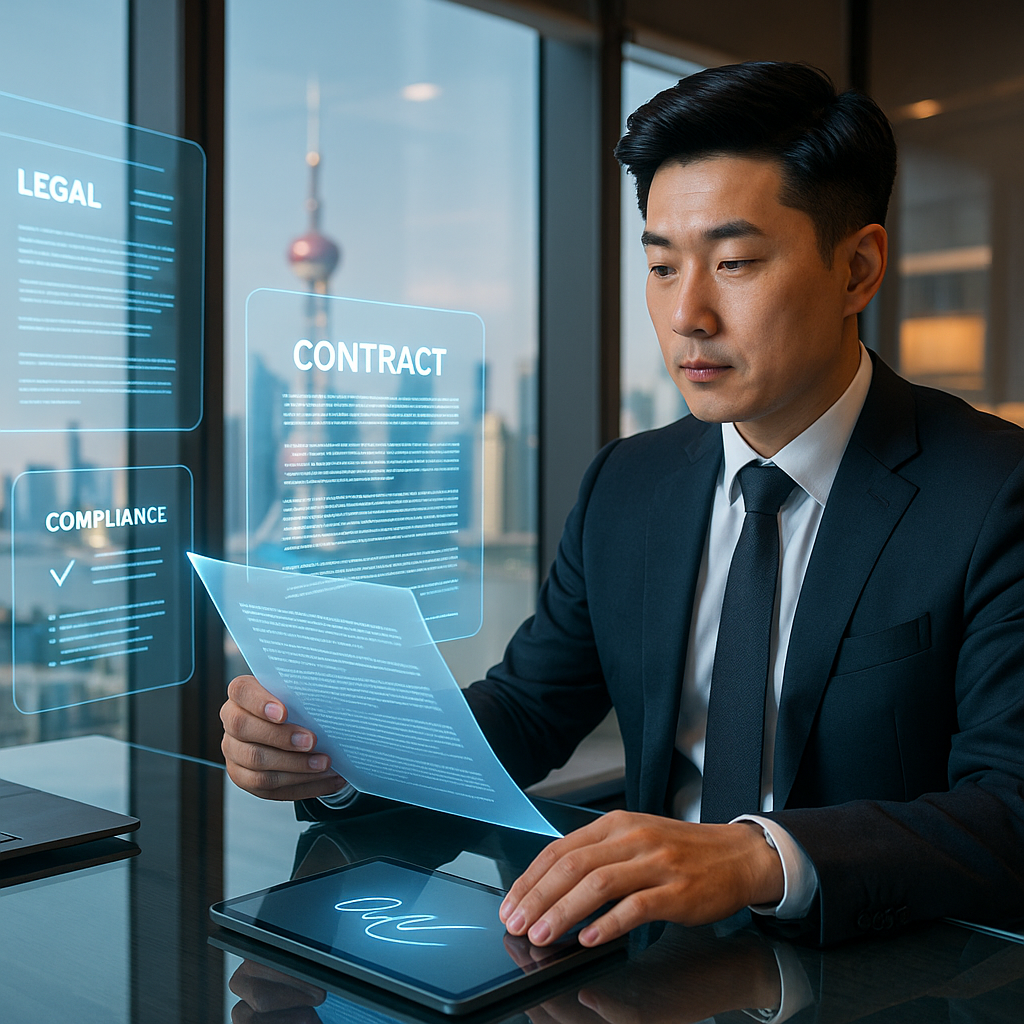
For businesses operating in or trading with China, this shift presents both opportunity and complexity. AI-powered contract drafting can accelerate deal-making, reduce costs, and improve consistency. But it also introduces new legal questions: Who’s liable when an AI drafts a flawed clause? How do you ensure AI-generated contracts comply with both Chinese regulations and international standards? What happens when a dispute arises over terms that no human actually wrote?
These questions matter because China’s legal environment is unique. Unlike Western common-law systems, China operates under civil law traditions with distinct interpretations of contract validity, enforceability, and dispute resolution. An AI trained on Western legal concepts might miss critical nuances that make or break a Chinese business contract. This is where specialized platforms like iTerms AI Legal Assistant become invaluable—they bridge the gap between international business needs and Chinese legal realities, ensuring AI-generated contracts aren’t just fast, but also accurate and enforceable.
China’s New Regulatory Framework for AI Content
China isn’t leaving AI development to chance. The country has implemented some of the world’s most comprehensive regulations governing AI-generated content, and these rules directly impact how businesses can use AI for contract drafting.
Starting September 1, 2025, new labeling rules took effect requiring explicit identification of AI-generated content. Under these regulations, any text, images, audio, video, or virtual content created by AI must carry visible markers indicating its artificial origin. For contracts, this means AI-generated drafts must be clearly identified as such—a requirement that affects transparency in business negotiations.
The regulations go further. Internet information service providers must review AI-generated content before release, identify AIGC markers, and add risk notices to unidentified or suspected AI content. This isn’t merely symbolic—it’s part of China’s broader strategy to manage AI risks while promoting innovation.
These requirements intersect with amendments to China’s Cybersecurity Law and emerging industry standards. For international legal professionals advising clients on China operations, understanding these regulations is critical. A contract drafted by AI without proper labeling could face questions about validity or enforceability. More importantly, businesses must ensure their AI tools comply with Chinese data protection standards, which often require data localization and strict controls on cross-border information flow.
The practical implications are significant. If you’re a foreign business owner negotiating with Chinese partners, you need to know whether their contract proposals were AI-generated and whether those tools meet Chinese regulatory standards. Similarly, if you’re using AI to draft contracts for Chinese transactions, you must ensure your platform complies with labeling requirements and data protection rules.
This is where the philosophy of iTerms AI Legal Assistant shines through—providing not just AI-powered drafting capabilities, but ensuring those capabilities are built on a foundation of Chinese legal compliance. With FaDaDa’s decade of experience in China’s electronic signature and legal technology market, iTerms understands that effective AI legal tools must be both innovative and compliant.
Judicial Developments: IP and Personality Rights in the AI Era
While regulations set the framework, Chinese courts are actively shaping how AI-generated content is treated under intellectual property and personality rights law. Recent judicial decisions reveal a nuanced, evolving approach that businesses must understand.
In April 2024, the Beijing Internet Court delivered China’s first-ever judgment on personality rights infringement through AI-generated content. The case established that personality rights extend to people’s virtual images—unauthorized creation or use of a person’s AI-generated virtual image constitutes infringement. This landmark ruling has profound implications for businesses using AI to create marketing materials, virtual representatives, or any content involving human likenesses.
Another case affirmed that voices recognizable by the relevant public are protected under personality rights. Commercial AI utilization of such voices requires authorization. For businesses, this means AI tools that generate audio content—including automated customer service systems or marketing materials—must navigate personality rights carefully.
On the copyright front, Chinese courts have ruled that AI-generated works can be copyrightable when they reflect original intellectual input from human beings. The Changshu People’s Court established that AI-generated images are eligible for copyright protection, while the Beijing Internet Court emphasized that prompt engineering and human direction can establish copyright in AI outputs.
These decisions create a complex landscape for businesses using AI to draft contracts. While the contract text itself might not raise personality rights issues, the broader AI ecosystem—including marketing materials, virtual negotiations, or multimedia contract presentations—does. Companies must assess whether their AI tools inadvertently create personality rights risks.
Global corporate clients are responding by updating their M&A due diligence processes. When acquiring Chinese companies or assets, buyers now investigate the target’s AI-generated content practices, assessing potential IP and personality rights liabilities. Smart businesses are incorporating AI governance clauses into their Chinese contracts, specifying who controls AI-generated content, how personality rights are protected, and how IP ownership is allocated.
The litigation trends are clear: Chinese courts are willing to protect both IP and personality rights in AI-generated content, but they require evidence of human intellectual contribution for copyright protection. For businesses, this means maintaining clear documentation of how AI tools are used, who provides creative direction, and how content is reviewed before deployment.
Corporate Transactions in the AI Age
The rise of AI in contract drafting is fundamentally reshaping corporate transactions involving Chinese entities. From M&A due diligence to contract clause design, businesses are adapting to a reality where AI plays a central role.
In merger and acquisition deals, due diligence now includes assessing the target company’s AI usage. Buyers want to know: What AI tools does the target use for contract drafting? Are those tools compliant with Chinese regulations? What liability exposure exists from AI-generated content? These questions are especially critical given China’s strict data localization requirements and cross-border data transfer restrictions.
The Cyberspace Administration of China (CAC) is activating a formal certification route for outbound personal data transfers starting January 1, 2026. This affects businesses using AI platforms that process Chinese personal data, including contract information containing personal details. Companies must ensure their AI legal assistants either process data within China or obtain proper certification for cross-border transfers.
Contract clauses themselves are evolving. Forward-thinking businesses are incorporating AI-specific provisions into their Chinese agreements, including:
- AI Disclosure Clauses: Requiring parties to disclose when AI was used in drafting, negotiation, or contract management.
- Liability Allocation: Specifying responsibility when AI-generated terms create disputes or compliance issues.
- Data Protection Provisions: Ensuring AI processing of contract data complies with Chinese data protection laws.
- Audit Rights: Allowing parties to verify AI tool compliance with applicable regulations.
For businesses dealing with Chinese partners, these clauses provide protection and clarity. They acknowledge the reality of AI usage while establishing accountability frameworks.
This is precisely where iTerms AI Legal Assistant provides reliable legal frameworks. Unlike general-purpose AI tools, iTerms is specifically designed for Chinese legal compliance, with built-in understanding of data protection requirements, contract enforceability standards, and regulatory obligations. When you use iTerms to draft a manufacturing agreement with a Shenzhen supplier or a distribution contract with a Beijing partner, you’re not just getting speed—you’re getting Chinese legal accuracy.
The platform’s template library, built from 10,000+ attorney-reviewed contracts, ensures that AI-generated drafts reflect both international best practices and Chinese legal requirements. This dual focus is critical because effective China business contracts must satisfy parties from different legal traditions while remaining enforceable in Chinese courts.
Employment, Privacy, and Compliance in AI-Driven Environments
AI’s integration into contract drafting extends into employment relationships and workplace compliance, creating new challenges for businesses operating in China.
As companies adopt AI tools for employment contracts, HR documentation, and workplace monitoring, they encounter China’s strict privacy and anti-discrimination laws. AI systems that analyze employee data—including contract performance, productivity metrics, or communication patterns—must comply with the Personal Information Protection Law (PIPL), which imposes stringent consent, purpose limitation, and transparency requirements.
The risk of algorithmic discrimination is real. If an AI tool generates employment contracts with terms that inadvertently discriminate based on protected characteristics, the employer faces liability. Chinese labor law strongly protects workers’ rights, and courts are increasingly scrutinizing AI-driven employment decisions.
Smart companies are adapting through comprehensive governance frameworks. These frameworks include:
- Risk Assessments: Regular audits of AI tools to identify potential privacy violations or discriminatory patterns.
- Human Oversight: Requiring human review of AI-generated employment contracts before execution.
- Transparency Measures: Informing employees when AI is used in contract generation or management.
- Data Minimization: Ensuring AI tools only access necessary employee information.
For expatriates living in China, understanding these protections is important. If your employer uses AI to draft or modify your employment contract, you have rights under Chinese law to understand how that AI operates, what data it uses, and how decisions are made. The integration of iTerms AI Legal Assistant’s philosophy here means advocating for AI systems that respect individual rights while delivering business efficiency.
International legal professionals advising corporate clients need to emphasize governance frameworks that balance innovation with compliance. This includes drafting AI usage policies, conducting privacy impact assessments, and establishing clear accountability when AI systems create legal risks.
The practical takeaway: AI in employment contracts isn’t just a technology question—it’s a compliance imperative. Businesses must ensure their AI tools align with Chinese labor law, privacy regulations, and anti-discrimination principles.
Competition Law and Consumer Protection in the AI Era
China’s approach to AI-generated content extends into competition law and consumer protection, areas that directly affect businesses using AI for customer-facing contracts and communications.
Chinese regulators are scrutinizing AI tools for potential antitrust concerns. If multiple businesses use the same AI platform for contract drafting, could that facilitate price coordination? If AI algorithms optimize contract terms based on competitive intelligence, does that constitute unfair competition? These questions are emerging as the Cyberspace Administration and market regulators develop enforcement strategies.
On consumer protection, China’s emphasis on transparency and fairness applies to AI-generated contracts. When businesses use AI to draft consumer agreements—whether for e-commerce, financial services, or digital products—they must ensure terms are clear, non-deceptive, and compliant with consumer protection standards.
The labeling requirements discussed earlier play a role here. Consumers have a right to know when AI generates contract terms, allowing them to assess whether those terms result from genuine negotiation or algorithmic optimization favoring the business. This transparency requirement reflects China’s broader consumer protection philosophy: fairness through disclosure.
Looking ahead to 2026 and beyond, we can expect continued regulatory evolution. China’s AI Plus Initiative aims for 70% AI adoption in intelligent terminals by 2027 and 90% smart device penetration by 2030. This massive integration will drive further refinement of competition and consumer protection rules.
For businesses, the opportunity lies in proactive adaptation. Rather than viewing these regulations as obstacles, forward-thinking companies recognize them as frameworks for responsible innovation. By using AI legal assistants that build compliance into their core functionality, businesses can accelerate contract processes while maintaining regulatory alignment.
The competitive advantage goes to companies that embrace AI thoughtfully. Roughly 70% of all AI-related patents now originate from China, according to Stanford University’s 2025 AI Index Report. This innovation leadership means Chinese AI tools and regulations will increasingly influence global standards. Businesses prepared for this reality will thrive; those caught off-guard will struggle.
Strategic Preparation for 2026 and Beyond
As we approach 2026, the legal AI landscape in China isn’t a distant possibility—it’s an imminent reality requiring strategic preparation.
For foreign business owners and entrepreneurs, the imperative is clear: integrate AI legal tools into your China operations, but choose platforms designed for Chinese legal compliance. General-purpose AI tools trained on Western legal concepts may miss critical nuances in Chinese contract law, enforcement procedures, or regulatory requirements. Specialized platforms like iTerms AI Legal Assistant offer the Chinese-specific expertise necessary for reliable contract generation.
Expatriates living in China should understand their rights regarding AI-generated contracts, whether in employment, housing, or commercial relationships. Know when AI has been used, ask questions about data processing, and ensure human oversight of critical contract terms. Your legal protections remain regardless of whether a human or AI drafted the contract.
International legal professionals face both challenges and opportunities. Clients expect faster turnaround times and lower costs—pressures that AI can help address. But professional responsibility requires ensuring AI tools meet ethical and legal standards. Partner with platforms that provide transparency, maintain human oversight, and demonstrate Chinese legal expertise.
Global corporate clients should view AI legal tools as strategic investments, not just cost-saving measures. The right platform accelerates deal-making, reduces compliance risks, and provides scalable solutions across multiple China operations. Companies like those in FaDaDa’s portfolio—including 200+ Fortune 500 firms—recognize that effective China operations require combining innovative technology with deep legal knowledge.
The future belongs to businesses that embrace AI legal tools while maintaining commitment to accuracy, compliance, and human judgment. This balanced approach—technology-enabled but human-guided—represents the philosophy at the heart of iTerms AI Legal Assistant.
As robots increasingly write your China business contracts, success depends not on resisting this transformation but on navigating it intelligently. Choose AI legal tools built on proven Chinese legal expertise, maintain human oversight of critical decisions, stay informed about regulatory evolution, and view AI as an enabler of better legal outcomes, not a replacement for legal wisdom.
The legal AI landscape of 2026 is arriving. With the right tools and strategic mindset, your business can not only adapt but thrive in this new environment. The question isn’t whether AI will transform China business contracts—it’s whether you’ll be ready when it does.